AI document intelligence for accounting uses artificial intelligence to capture, classify, extract, validate, and process information from financial and accounting documents.
How AI Document Intelligence Is Transforming Accounting in 2026
Listen to this article
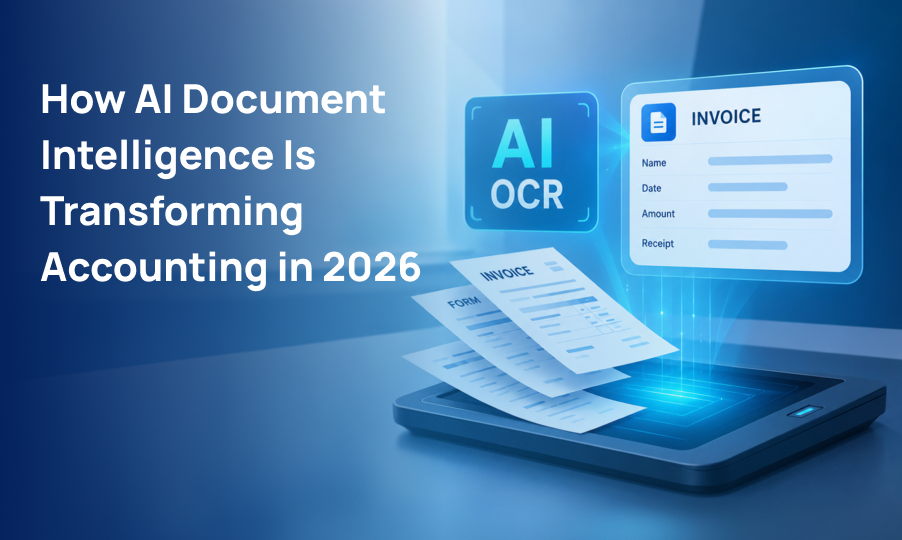
Accounting teams work with a constant flow of financial documents, including invoices, receipts, purchase orders, bank statements, tax documents, expense reports, and financial records. Processing this information manually can consume valuable time and increase the risk of data entry errors.
AI document intelligence for accounting is changing how businesses handle these document-heavy processes. By combining artificial intelligence, document processing, data extraction, and workflow automation, organizations can turn information from financial documents into structured and usable data.
Instead of spending hours manually reading documents and entering information into accounting systems, teams can use AI to extract relevant data, classify documents, validate information, and support automated workflows.
Table of Contents
- What Is AI Document Intelligence for Accounting?
- Why Accounting Teams Need Document Intelligence
- How AI Document Intelligence Works in Accounting
- Types of Accounting Documents AI Can Process
- Key Benefits of AI Document Intelligence for Accounting
- Common Use Cases
- AI Document Intelligence vs. Traditional OCR
- AI Document Intelligence and Accounting Workflow Automation
- Challenges of Implementing AI Document Intelligence
- The Future of AI in Accounting
- Conclusion
What Is AI Document Intelligence for Accounting?
AI document intelligence for accounting refers to the use of artificial intelligence to understand, extract, classify, validate, and process information from accounting and financial documents.
Traditional accounting processes often require employees to manually review documents and enter information into accounting or enterprise systems.
AI-powered document intelligence can automate many of these repetitive activities.
For example, when an accounting team receives an invoice, an AI-powered system can identify the document, extract information such as the supplier name, invoice number, date, tax, and total amount, and then send the extracted information to the appropriate workflow.
This makes document intelligence for accounting more than simple text recognition. The goal is to understand the information contained in a document and make it useful for downstream accounting processes.
Why Accounting Teams Need Document Intelligence
Accounting departments manage large volumes of documents every day. As businesses grow, the amount of financial information that needs to be processed can grow significantly as well.
Manual document processing can create several challenges, including:
- Repetitive data entry
- Human errors
- Slow invoice processing
- Duplicate records
- Difficulty locating documents
- Delayed approvals
- Inconsistent data
- High administrative workload
For accounting teams, even small data-entry errors can create additional work during reconciliation, reporting, or audits.
AI document processing for accounting can help reduce repetitive work by automatically capturing and organizing important information from financial documents.
This allows accounting professionals to spend more time on analysis, financial planning, reconciliation, and decision-making rather than routine document handling.
How AI Document Intelligence Works in Accounting
AI document intelligence typically combines several technologies to process financial documents.
1. Document Capture
Documents can enter the system through email, uploads, scanners, digital forms, or connected business applications.
The system collects the documents and prepares them for processing.
2. Document Classification
AI identifies what type of document has been received.
For example, it can distinguish between:
- Invoices
- Receipts
- Purchase orders
- Bank statements
- Expense reports
- Tax documents
- Contracts
- Financial statements
This allows each document to follow the appropriate workflow.
3. Data Extraction
AI extracts relevant information from the document.
For an invoice, this could include:
- Vendor name
- Invoice number
- Invoice date
- Purchase order number
- Line items
- Quantity
- Tax
- Total amount
- Payment terms
This AI document extraction process reduces the need for employees to manually enter financial information.
4. Data Validation
Extracted information can be checked against accounting records, business rules, or other relevant documents.
For example, an invoice can be compared with a purchase order to identify mismatched amounts or other inconsistencies.
5. Workflow Automation
Once the information has been extracted and validated, the document can automatically move through the appropriate accounting workflow.
For example:
Invoice received → Data extracted → Information validated → Approval → Accounting system → Payment processing
This helps create a more efficient accounting process.
6. Data Storage and Retrieval
Processed documents and extracted information can be stored in centralized systems.
Accounting teams can then search and retrieve financial records more easily when needed for reporting, reconciliation, audits, or internal reviews.
Types of Accounting Documents AI Can Process
AI document intelligence can support many types of financial and accounting documents.
Invoices
AI can extract invoice information and help automate invoice processing, validation, and approval workflows.
Receipts
Receipt information can be captured and categorized, helping simplify expense reporting and record keeping.
Purchase Orders
Purchase order data can be extracted and compared with invoices or other purchasing records.
Bank Statements
AI can help extract transaction information from bank statements and prepare data for further accounting processes.
Expense Reports
Expense-related documents can be processed and categorized according to predefined accounting rules.
Tax Documents
AI can help organize and extract information from various tax-related documents, reducing manual document handling.
Financial Statements
Financial documents can be processed and converted into structured information that can support analysis and reporting.
Key Benefits of AI Document Intelligence for Accounting
Reduces Manual Data Entry
One of the biggest benefits of AI accounting automation is reducing repetitive data-entry tasks.
Instead of manually entering information from every invoice, receipt, or statement, accounting teams can use AI to capture relevant information automatically.
Improves Data Accuracy
Manual entry can result in typing mistakes, missing information, or incorrect values.
AI-powered extraction and validation can help reduce these errors and improve the quality of accounting data.
Speeds Up Document Processing
Financial documents can be processed faster when information is automatically extracted and routed through predefined workflows.
This can help reduce delays in invoice approvals, expense processing, and other accounting activities.
Improves Operational Efficiency
Automation allows accounting professionals to spend less time on repetitive document-related tasks and more time on higher-value activities.
Improves Document Visibility
Centralized digital records make it easier for accounting teams to find documents and track their status.
Supports Business Growth
As the number of financial transactions and documents increases, automated systems can help accounting teams manage higher volumes without relying entirely on additional manual processing.
Common Use Cases of AI Document Intelligence in Accounting
Automated Invoice Processing
AI can extract invoice information, validate data, identify discrepancies, and route invoices for approval.
This can significantly reduce the manual effort involved in accounts payable processes.
Accounts Payable Automation
AI can support accounts payable teams by processing invoices, matching documents, identifying exceptions, and moving approved information through payment workflows.
Expense Management
Receipt and expense documents can be automatically captured and categorized, helping accounting teams process employee expenses more efficiently.
Bank Reconciliation
AI can extract transaction information from financial documents and help prepare data for reconciliation workflows.
Tax Document Processing
Financial and tax-related documents can be organized and processed to make relevant information easier to access.
Financial Data Extraction
Organizations can use AI to convert information from unstructured financial documents into structured data that can be used for accounting, reporting, and analysis.
AI Document Intelligence vs. Traditional OCR
Traditional OCR, or Optical Character Recognition, is primarily designed to recognize and convert text from images and scanned documents.
While OCR can be useful for digitizing documents, it may not fully understand the meaning or context of the extracted information.
AI-powered document intelligence goes further by combining OCR with AI technologies that can classify documents, understand context, extract relevant fields, and support decision-based workflows.
| Traditional OCR | AI Document Intelligence |
|---|---|
| Converts images into text | Understands document content and context |
| Primarily text-focused | Data and context-focused |
| Often relies on predefined structures | Can handle more document variations |
| Limited workflow capabilities | Can connect with automated workflows |
| Requires more manual validation | Can support automated validation |
For accounting teams dealing with different suppliers, formats, and financial documents, intelligent processing can provide greater flexibility.
AI Document Intelligence and Accounting Workflow Automation
Document processing becomes more valuable when it is connected to broader accounting workflows.
For example, an automated invoice process can connect document extraction with:
- Purchase order matching
- Approval workflows
- Accounting systems
- Payment processes
- Exception handling
- Reporting
This creates accounting workflow automation, where information moves between different stages with less manual intervention.
Organizations can combine AI & Intelligent Systems with document intelligence and automation to create connected workflows around their existing business processes.
Challenges of Implementing AI Document Intelligence
While AI document intelligence can provide significant benefits, businesses should consider several factors before implementation.
Document Quality
Poor-quality scans, handwritten information, incomplete documents, and inconsistent layouts can make automated processing more challenging.
A strong system should include validation and exception-handling capabilities.
Integration With Existing Systems
AI document intelligence often needs to connect with accounting software, ERP platforms, document management systems, and other business applications.
Effective integration is important for creating an end-to-end process.
Data Security
Accounting documents can contain sensitive financial and business information.
Organizations should implement appropriate security controls, access management, and data protection practices.
Businesses can strengthen their broader technology environment through Cybersecurity solutions.
Human Oversight
Not every financial document should be processed without human review.
Unusual transactions, exceptions, unclear information, or high-risk financial decisions may still require accounting professionals to review and approve the information.
The best approach is often to automate repetitive tasks while keeping humans involved where judgment is required.
How AI Is Transforming Accounting Workflows
AI document intelligence is helping accounting teams move away from document-heavy manual processes toward more automated and data-driven workflows.
Instead of treating each document as a separate task, organizations can connect document processing with accounting systems and business processes.
For example, an invoice can move through the entire process automatically:
Document received → Information extracted → Data validated → Purchase order matched → Approval triggered → Accounting system updated
This reduces the number of manual steps and provides greater visibility into the overall process.
Once financial documents are converted into structured data, organizations can also use analytics to identify spending patterns, processing bottlenecks, and other financial insights.
Businesses can connect these capabilities with Data & Analytics solutions to make better use of the information generated through accounting processes.
The Future of AI in Accounting
The role of AI in accounting is expected to extend beyond document processing.
Future AI-powered accounting systems can combine document intelligence, automation, analytics, and AI assistants to support more complex financial workflows.
For example, accounting professionals may be able to ask an AI system questions about financial documents, summarize large sets of records, identify unusual transactions, or quickly locate specific information across thousands of documents.
The long-term opportunity is not simply to digitize accounting documents. It is to create intelligent financial workflows where information can be captured, understood, validated, and acted upon automatically.
This can help accounting teams become more efficient while allowing professionals to focus on analysis, strategy, and financial decision-making.
Conclusion
AI document intelligence for accounting can help businesses automate financial document processing, reduce repetitive data entry, improve data accuracy, and create faster accounting workflows.
By combining AI document processing, intelligent document processing, data extraction, and workflow automation, organizations can transform unstructured financial documents into structured and actionable information.
The biggest opportunity is not simply automating individual documents. It is connecting document intelligence with accounting systems and business workflows to create a more efficient end-to-end process.
As financial operations become increasingly digital, AI document intelligence can become an important technology for accounting teams looking to improve efficiency, scalability, and data-driven decision-making.
Ready to take the next step?
Frequently Asked Questions
AI can process invoices, receipts, purchase orders, expense reports, bank statements, tax documents, contracts, and other financial records.
AI can reduce manual data entry, extract information automatically, validate financial data, speed up document processing, and support automated accounting workflows.
OCR primarily converts text from scanned documents or images into digital text. AI document intelligence goes further by understanding document context, extracting specific information, classifying documents, and supporting automated workflows.
Yes. AI document intelligence can be integrated with accounting, ERP, document management, and other enterprise systems to support end-to-end financial workflows.
AI document intelligence can be implemented with appropriate security controls, access permissions, data protection measures, and compliance processes. The specific security approach depends on the technology and business environment.
No. AI is primarily useful for automating repetitive document and data-processing tasks. Accounting professionals remain important for reviewing exceptions, making financial decisions, interpreting information, and providing strategic oversight.