
AI models
Amazon Bedrock: Meta Llama 3, Amazon Titan embeddings
Writes glossary entries; makes content searchable by meaning
The same business term meant different things to different teams, and definitions were written in technical language few people could follow. We used generative AI to build a consistent business glossary automatically from the company's own data and documents.
| Industry | Engagement | Duration | Platform |
|---|---|---|---|
| Insurance | Managed, offshore delivery | 8 weeks | Amazon Web Services |
An insurance company needed everyone to mean the same thing when they used the same business term. Three problems stood in the way.
One word, several meanings. Different teams had their own definitions for the same term, which confused the people using the data and the reports built on it.
No single source of truth. There was no one place to check what a term meant, so definitions drifted further apart over time.
Definitions nobody could read. Where definitions existed, they were written in technical language that business users found hard to understand.
Writing and maintaining a glossary by hand across the company's data would have taken a great deal of expert time.
We automated glossary creation around three decisions.
Start from the company's own data. The glossary is built from the company's documents and the metadata of its data tables, such as column names, so every term reflects how the business actually uses it.
Ground every definition in source material. Using retrieval-augmented generation, the model finds the relevant content first, then writes a plain-language term and description from it, rather than relying on general knowledge.
Keep terms uniform. Prompts follow a defined structure, so every glossary entry is written the same way and the same term always gets the same definition.
The build ran over 8 weeks as a managed engagement with offshore delivery, entirely within the company's AWS account. It came together in four parts.
Content pipeline. Source material, including PDFs, documents and web pages, lands in Amazon S3. Amazon Titan embeddings on Amazon Bedrock make it searchable by meaning, and the results are stored in Amazon OpenSearch as a vector database.
Table metadata. Column names from the company's data tables are pulled from the AWS Glue Data Catalog and added to the prompt, so terms match the fields people actually see in their data.
Glossary generation. For each term, the most relevant content is retrieved and combined with the table metadata. Meta Llama 3 on Amazon Bedrock then writes the business term and its plain-language description.
Access. Business users work through a Streamlit app hosted on Amazon EC2, reached through Amazon API Gateway with Okta sign-in. Data scientists maintain the solution's code in GitHub.
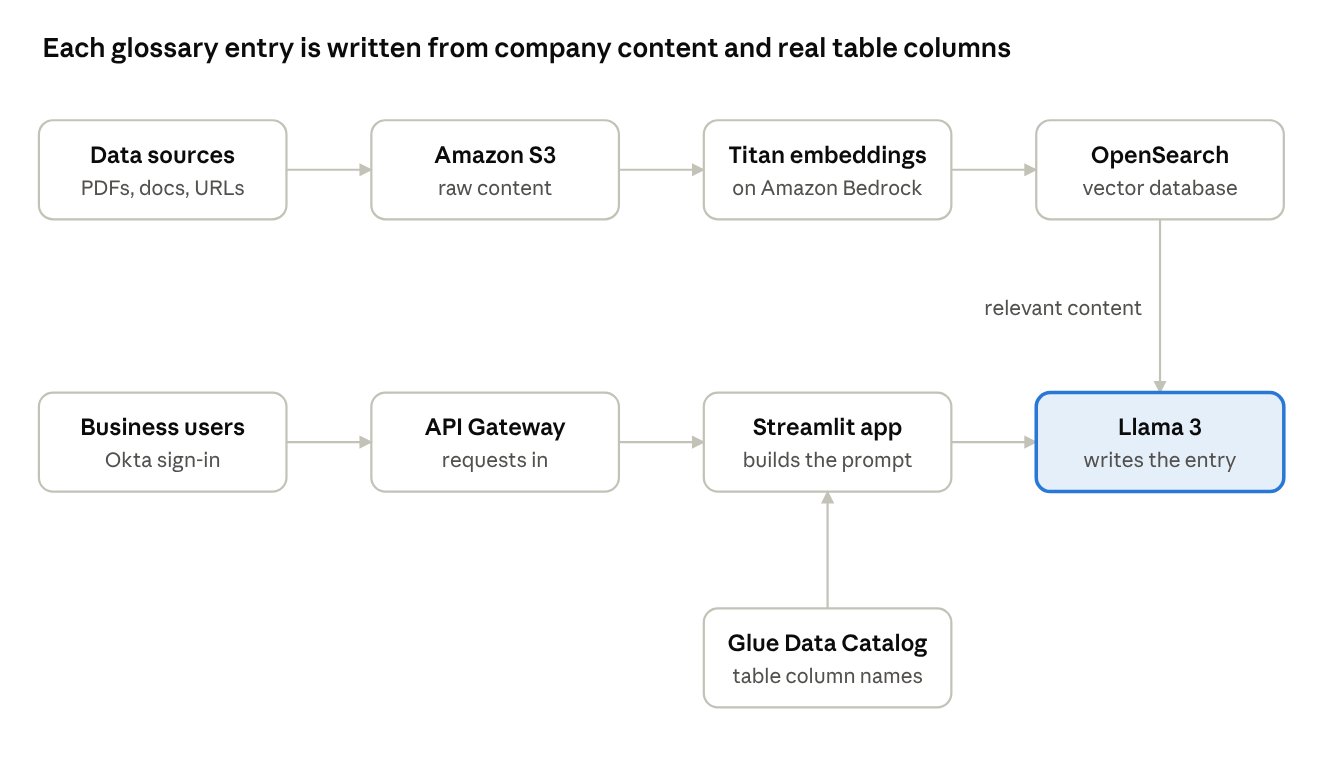
Results reported after launch:
| Result | What changed |
|---|---|
| Single source of truth | One agreed definition for each business term, in one place |
| Faster delivery | Glossary terms and descriptions generated automatically instead of written by hand |
| Plain-language definitions | Descriptions business users can read, with consistent wording across every entry |
Fewer misunderstandings. Teams work from the same definitions, so reports and decisions mean the same thing to everyone.
Higher productivity. Data and business teams spend less time chasing what a term means or writing definitions themselves.
Easier collaboration. A shared vocabulary makes it simpler for technical and business teams to work together.
Reusable enterprise knowledge. The glossary becomes a lasting company asset that new data, reports and AI tools can build on.
Amazon Bedrock: Meta Llama 3, Amazon Titan embeddings
Writes glossary entries; makes content searchable by meaning
Amazon OpenSearch
Vector database for retrieval
Amazon S3, AWS Glue Data Catalog
Source content; table and column metadata
Streamlit on Amazon EC2, Amazon API Gateway
User interface and request handling
Amazon SageMaker, AWS Lambda
Additional AWS services used in the solution
Okta
User sign-in
GitHub
Version control for the data science team