Amazon PPC vs Amazon SEO for B2B Brands | Which to Choose?
Listen to this article
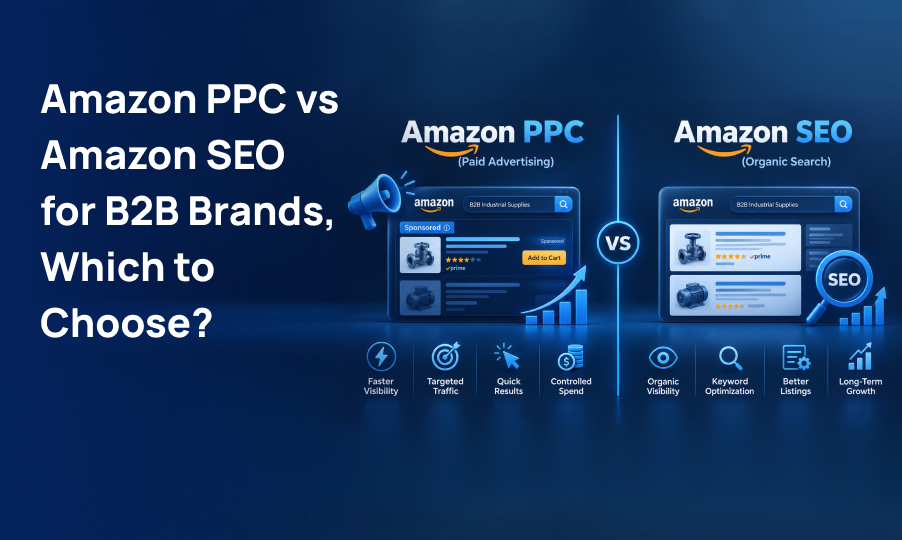
Table of Contents

- Amazon PPC vs Amazon SEO: What’s the Difference?
- What Is Amazon SEO for B2B Brands?
- What Is Amazon PPC for B2B Brands?
- Amazon PPC vs Amazon SEO: Key Differences
- When Should B2B Brands Invest in Amazon SEO?
- When Should B2B Brands Invest in Amazon PPC?
- When Should B2B Brands Use Amazon PPC and SEO Together?
- Amazon PPC vs Amazon SEO for Manufacturers
- How to Decide Between Amazon PPC and Amazon SEO
- Common Amazon PPC and SEO Mistakes B2B Brands Should Avoid
- How Much Should B2B Brands Invest in Amazon PPC and SEO?
- Amazon PPC vs Amazon SEO: Which Is Better for B2B Brands?
- Conclusion
- FAQs
Amazon PPC vs Amazon SEO: What’s the Difference?
Amazon PPC and Amazon SEO can both improve product visibility, but they work in different ways.
Amazon PPC uses paid advertising to place products in sponsored positions. With Sponsored Products, advertisers choose targeting, bids, and budgets and pay when shoppers click.
Amazon SEO focuses on improving product listings so Amazon can better understand, index, and rank them for relevant searches.
For B2B brands, the right choice depends on the product, sales goals, competition, catalog size, and available budget.
What Is Amazon SEO for B2B Brands?
Amazon SEO is the process of improving product listings to increase organic visibility on Amazon.
Product Title Optimization
B2B products often have technical names, specifications, models, and applications. A strong title should clearly explain what the product is and how buyers may search for it.
Keyword Optimization
B2B buyers may use highly specific searches such as product type, material, size, industry, application, or model number.
Using relevant search terms across the listing helps Amazon understand the product and match it with relevant searches.
Product Content Optimization
Amazon SEO can include optimizing:
- Product titles
- Bullet points
- Product descriptions
- Backend search terms
- Images
- A+ Content
- Product attributes
Long-Term Organic Visibility
Unlike paid advertising, organic visibility does not require paying for every click. However, SEO requires ongoing optimization, testing, and monitoring.
What Is Amazon PPC for B2B Brands?
Amazon PPC is a paid advertising strategy designed to put products in front of shoppers who are actively searching or browsing.
Sponsored Products
Sponsored Products are CPC ads that promote individual product listings and can appear in shopping results and on product pages.
Keyword and Product Targeting
B2B brands can use keyword targeting to reach shoppers searching for specific products and use product targeting to reach shoppers viewing relevant products.
Faster Visibility
PPC can generate visibility as soon as campaigns begin receiving impressions and clicks, making it useful for new products, competitive categories, seasonal demand, and important product launches.
Campaign Data
PPC also provides useful data about searches, clicks, conversions, bids, and spending. B2B brands can use these insights to identify valuable search terms and improve their overall Amazon strategy.
Amazon PPC vs Amazon SEO: Key Differences
Speed of Results
PPC can provide visibility quickly once campaigns are live. SEO generally takes longer because organic rankings need to develop over time.
Cost
PPC requires an advertising budget and charges based on clicks. Amazon states that Sponsored Products use a cost-per-click, auction-based model.
SEO does not charge a direct cost per click, but it still requires investment in keyword research, listing optimization, content, testing, and management.
Control
PPC gives brands more direct control over bids, budgets, targeting, and campaigns.
SEO provides less direct control because organic rankings depend on Amazon's search and ranking systems.
Long-Term Value
PPC can deliver immediate traffic but depends on continued advertising spend.
SEO can build organic visibility that continues generating traffic without paying for every click.
When Should B2B Brands Invest in Amazon SEO?
Your Product Listings Need Improvement
If your listings have weak titles, unclear bullet points, missing attributes, or poor keyword targeting, SEO should be addressed before increasing ad spend.
You Want Long-Term Organic Growth
B2B brands selling products with consistent search demand can benefit from building stronger organic visibility over time.
You Have a Large Product Catalog
Manufacturers and distributors with many SKUs can benefit from systematic listing and keyword optimization across their catalog.
Your Products Have Strong Search Intent
Technical products often have specific buyer searches. Optimizing listings around relevant product terms, specifications, and applications can help improve discoverability.
When Should B2B Brands Invest in Amazon PPC?
You Are Launching a New Product
New products often need visibility and traffic. PPC can help put a new listing in front of relevant shoppers while you collect performance data.
You Need Faster Visibility
If organic rankings are not yet generating enough traffic, PPC can provide an additional source of visibility.
You Are Entering a Competitive Category
For competitive products, paid placements can help brands reach shoppers while their organic rankings develop.
You Have a Strong-Converting Listing
PPC works best when the product page is ready to convert visitors. Spending more on ads will not solve fundamental problems with weak content, poor images, pricing, or an unclear value proposition.
When Should B2B Brands Use Amazon PPC and SEO Together?
Use SEO as the Foundation
Before scaling advertising, make sure your product listings are properly optimized for relevant searches and provide the information B2B buyers need.
Use PPC to Accelerate Visibility
Once the listing is ready, PPC can help bring targeted traffic and generate performance data.
Use PPC Data to Improve SEO
Search-term and conversion data from PPC can reveal how customers search for products. Those insights can help inform future listing optimization.
Reduce Dependence on Paid Traffic Over Time
As organic visibility improves, brands can evaluate where paid advertising is creating incremental value and where spend can be adjusted.
Amazon PPC vs Amazon SEO for Manufacturers
Manufacturers often have different requirements from typical consumer brands.
Technical Product Searches
Industrial and B2B buyers may search using model numbers, specifications, materials, dimensions, certifications, or applications.
Larger Product Catalogs
Manufacturers may have hundreds or thousands of products. This makes scalable listing optimization and catalog management especially important.
Longer Buying Considerations
B2B purchases can involve specifications, quantities, compatibility, pricing, and procurement requirements. Product content needs to provide enough information to support these decisions.
Amazon Business Opportunities
Amazon also provides advertising opportunities for business buyers through Amazon Business, making paid visibility relevant to B2B brands targeting professional and organizational customers.
How to Decide Between Amazon PPC and Amazon SEO
Choose SEO First If
- Your listings are poorly optimized
- Your organic visibility is weak
- Your product pages have content gaps
- You want sustainable organic growth
- You have strong long-term search demand
Choose PPC First If
- You need faster visibility
- You are launching a new product
- Your listing already converts well
- You want immediate traffic
- You need data to identify valuable search terms
Choose Both If
- You want both short-term and long-term growth
- You have enough budget for advertising and optimization
- You are competing in a crowded category
- You have a large product catalog
- You want to build organic visibility while scaling paid traffic
Common Amazon PPC and SEO Mistakes B2B Brands Should Avoid
Spending on PPC Before Fixing the Listing
Driving paid traffic to a weak product page can result in wasted clicks and poor conversion.
Treating SEO as a One-Time Task
Product searches, competitors, and customer behavior change. Listings should be reviewed and improved regularly.
Focusing Only on High-Volume Keywords
B2B brands should also consider specific, high-intent searches that closely match their products and applications.
Measuring PPC Only by Sales
Sales matter, but B2B brands should also monitor metrics such as CTR, conversion rate, CPC, ACoS, ROAS, and TACoS to understand campaign efficiency.
Running PPC and SEO Separately
Using different keyword strategies for advertising and organic optimization can create missed opportunities. The strongest approach is to use insights from both areas together.
How Much Should B2B Brands Invest in Amazon PPC and SEO?
Consider Your Product Stage
New products may need more paid visibility, while established products with strong organic rankings may require a different allocation.
Consider Your Competition
Highly competitive categories may require more advertising investment while the brand works on improving organic rankings.
Consider Your Margins
B2B brands should evaluate advertising spend against product margins, customer value, and overall profitability.
Review Performance Regularly
Instead of following a fixed percentage split, adjust investment based on organic ranking, advertising performance, conversion rate, sales, and profitability.
Amazon PPC vs Amazon SEO: Which Is Better for B2B Brands?
Neither strategy is automatically better.
Amazon PPC is useful when a B2B brand needs faster visibility, product launches, testing, or additional traffic. Amazon SEO is more valuable when the goal is sustainable organic visibility and stronger long-term discoverability.
For many B2B brands, the better approach is to use SEO as the foundation and PPC as an accelerator.
Conclusion
Amazon PPC and Amazon SEO should not always be treated as competing strategies. PPC can provide faster visibility and valuable search data, while SEO can help build long-term organic visibility.
For B2B brands, the right investment depends on product complexity, catalog size, competition, margins, business goals, and the current strength of the Amazon listings.
The best strategy is to understand what is limiting growth first, then invest in PPC, SEO, or both based on that gap.
Ready to take the next step?
Frequently Asked Questions
It can be, especially when B2B products have clear search demand and the listing is optimized to convert relevant traffic.
Yes. A strong listing gives paid traffic a better chance of converting and helps ensure advertising spend is not being wasted on a poorly presented product.
Important metrics include impressions, CTR, CPC, conversion rate, ACoS, ROAS, and TACoS. The right metrics depend on the campaign objective.