Enterprise technology modernization is the process of updating legacy applications, data systems, cloud infrastructure, and business processes to improve scalability, security, efficiency, and operational resilience. It can include cloud migration, data platform modernization, application engineering, and automation.
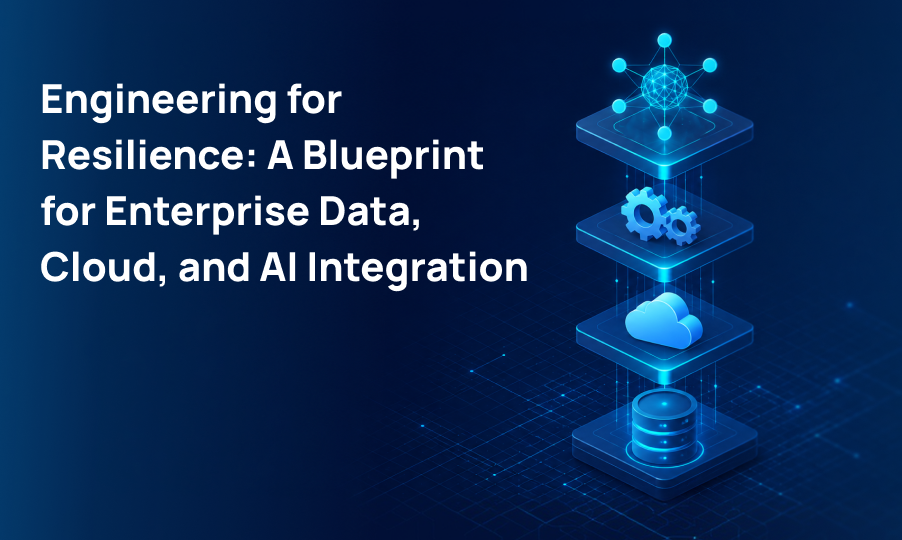
Engineering for Resilience: A Blueprint for Enterprise Data, Cloud, and AI Integration
Listen to this article
Modern enterprises rarely struggle because they lack technology. The bigger challenge is making existing systems, data, applications, and emerging AI capabilities work together without creating additional complexity.
Legacy applications continue to support critical operations while cloud infrastructure enables scalability and flexibility. At the same time, enterprise data platforms are becoming increasingly important for analytics and decision-making, while AI automation is creating new opportunities to streamline repetitive processes.
The challenge is integration. Organizations need an architecture that supports modernization without sacrificing stability, security, or operational continuity.
A pragmatic modernization strategy connects enterprise data platforms, cloud infrastructure, scalable application engineering, and business automation into a cohesive technology ecosystem. Rather than replacing everything at once, enterprises can modernize incrementally, prioritize high-value use cases, and build an architecture capable of evolving with business requirements.
Table of Contents
The Architecture Challenge in Modern Enterprise Systems
Many enterprise environments have evolved over decades. New applications are frequently added to solve immediate business requirements, while older systems remain because they continue to perform critical functions.
Over time, this creates fragmented architecture.
Data may exist across multiple databases, applications may rely on outdated integrations, and different business units may use disconnected technology stacks. These silos increase technical debt and make even relatively simple changes difficult.
The impact goes beyond IT complexity. Fragmented systems can result in:
- Duplicate or inconsistent data
- Manual processes between applications
- Increasing maintenance costs
- Slow application development
- Limited visibility across business operations
- Higher cybersecurity and compliance risks
- Difficulty introducing AI capabilities
This is why modernization should not simply mean moving workloads to the cloud. A successful transformation considers how applications, data, infrastructure, and business processes interact.
The goal is to move from reactive maintenance toward strategic modernization, creating enough stability to protect existing operations while giving engineering teams the flexibility to deliver new capabilities.
Foundation First: Structuring Enterprise Data Platforms
Data is one of the most important foundations of enterprise modernization.
Organizations often begin with operational databases, departmental data warehouses, data lakes, and application-specific repositories. While each may serve a purpose, disconnected data environments make it difficult to establish a reliable view of business information.
Modern enterprise data platforms can provide a more unified foundation.
Instead of treating the data lake or warehouse as a standalone destination, enterprises can build an integrated architecture that connects operational systems, analytical workloads, APIs, cloud services, and AI applications.
This requires addressing several challenges.
Integrating Legacy and Cloud Environments
Legacy databases rarely disappear overnight. They may contain years of business-critical information and support applications that cannot easily be replaced.
Modern integration strategies can connect these systems with cloud environments through APIs, event-driven architectures, data replication, and managed integration services.
This allows organizations to modernize their data architecture incrementally rather than creating unnecessary disruption.
Improving Data Quality and Governance
Data integration is only valuable when the resulting information can be trusted.
Enterprises should establish:
- Data ownership and governance policies
- Validation and quality controls
- Metadata management
- Access controls
- Data lineage
- Pipeline monitoring
- Real-time anomaly detection
These capabilities become particularly important when AI systems depend on enterprise data. Poor-quality data can produce unreliable analytics, inaccurate automation, and weak AI outputs.
A strong data foundation therefore becomes an enabler for both analytics and ai process automation.
Pragmatic Automation: Beyond the AI Hype
AI adoption should begin with business problems, not technology trends.
Organizations frequently identify opportunities for business automation but attempt to automate processes that are poorly defined, highly variable, or dependent on complex human judgment.
The better approach is to evaluate processes based on business impact, frequency, complexity, risk, and automation readiness.
High-value opportunities often include repetitive processes such as:
- Document classification and extraction
- Invoice processing
- Customer request routing
- IT ticket classification
- Data validation
- Report generation
- Employee onboarding workflows
- Incident triage
Depending on the process, enterprises can combine traditional automation, APIs, machine learning, and generative AI.
This is where workflow automation services can help organizations connect individual automated tasks into complete business workflows rather than automating isolated activities.
For more complex operational environments, business process automation services can be used to redesign and automate processes across multiple systems, departments, and applications.
Combining AI With Business Processes
AI automation for business is most valuable when AI capabilities are integrated into existing workflows.
For example, an enterprise service desk could use AI to analyze incoming requests, classify incidents, identify potential causes, and recommend the next action. A human employee can then review the recommendation before the workflow continues.
This human-in-the-loop model provides a practical balance between automation and control.
Organizations evaluating these opportunities may also benefit from ai automation consulting to identify processes where AI can produce measurable improvements without introducing unnecessary technical or compliance risks.
Similarly, business process automation consulting can help organizations assess existing workflows, identify bottlenecks, prioritize automation opportunities, and develop an implementation roadmap.
AI-Enhanced IT Operations
AI can also improve IT operations.
AI-enhanced IT services can support capabilities such as:
- Intelligent log analysis
- Automated incident categorization
- Predictive issue detection
- Automated knowledge retrieval
- Root-cause analysis
- Document processing
- IT service request routing
Traditional automation remains useful for deterministic tasks, while AI can assist with processes involving unstructured information or variable inputs.
For organizations with repetitive, rules-based workloads, RPA consulting services can complement AI initiatives by identifying processes suitable for robotic process automation.
The objective should not be maximum automation. It should be appropriate automation using the right technology for the right process.
Engineering for Scale: Cloud Infrastructure and Application Design
Once data and automation foundations are established, enterprises need infrastructure capable of supporting changing workloads.
Modern cloud infrastructure provides access to elastic compute, managed databases, container platforms, serverless services, and distributed architectures. However, simply moving applications to the cloud does not automatically make them scalable or cost-efficient.
Applications should be designed around the characteristics of their workloads.
Architectural approaches may include:
- Containerized application deployment
- Microservices where appropriate
- Event-driven architectures
- API-first integration
- Serverless workloads
- Automated infrastructure provisioning
- Distributed caching
- Asynchronous processing
These approaches can support scalable application engineering across hybrid and multi-cloud environments.
However, enterprises should avoid adopting architectural patterns simply because they are popular. A monolithic application that is stable, well understood, and cost-effective may not need to become a collection of microservices.
Modernization should be driven by measurable business and engineering requirements.
Optimizing Cloud Costs
Cloud scalability can also introduce unnecessary spending.
Organizations should continuously evaluate:
- Compute utilization
- Storage requirements
- Database capacity
- Network traffic
- Licensing
- Reserved and committed-use opportunities
- Autoscaling configurations
- Workload placement
Cost optimization should be treated as an engineering discipline rather than a one-time migration exercise.
Security must also be integrated into the architecture. Identity management, encryption, vulnerability scanning, secrets management, access controls, and compliance testing should become part of the development and deployment lifecycle.
Maintaining Uptime: Continuous Operational Support
Modernization does not eliminate operational requirements.
Even well-designed cloud and data environments require continuous monitoring, maintenance, security updates, performance optimization, and incident response.
Traditional break-fix IT models react after a problem occurs. Modern enterprises increasingly need proactive monitoring that can identify potential issues before they become business-impacting incidents.
This includes monitoring:
- Application performance
- Infrastructure health
- Database performance
- Network availability
- Security events
- Integration failures
- Data pipeline health
- Cloud resource utilization
A structured 24/7 managed IT support model can provide continuous operational coverage for critical systems, including incident response, patch management, monitoring, escalation, and SLA management.
AI can further strengthen these operations by identifying patterns across large volumes of logs and operational data.
The result is a shift from simply responding to failures toward predicting and preventing them wherever possible.
Key Architectural Takeaways
Enterprise modernization does not require organizations to replace their entire technology stack simultaneously.
A more resilient approach starts with the foundations and modernizes incrementally.
The strongest modernization strategies are not necessarily the most technologically ambitious. They are the ones that connect technology investment to measurable business outcomes.
By combining modern enterprise data platforms, resilient cloud infrastructure, intelligent business automation, and scalable application engineering, enterprises can reduce technical debt while creating a foundation for continuous innovation.
The question is no longer whether enterprises should modernize. It is how they can modernize without sacrificing the stability that their existing business depends on.
Ready to take the next step?
Frequently Asked Questions
AI automation can handle repetitive and data-intensive activities such as document processing, incident classification, customer request routing, data validation, and workflow decision support. AI automation for business is most effective when integrated into existing workflows with appropriate human oversight.
Workflow automation services can connect multiple applications, teams, and processes to reduce manual work, minimize errors, accelerate task completion, and improve process visibility. They are particularly useful when organizations need to automate an entire workflow rather than a single repetitive task.
No. Not every legacy application needs to be migrated or replaced. Enterprises should evaluate each system based on business criticality, performance, maintenance costs, security requirements, scalability needs, and modernization benefits. In some cases, improving integration with existing cloud infrastructure may be more practical than completely replacing the system.
Enterprises can reduce modernization risks by taking an incremental approach, establishing strong data governance, implementing security throughout the development lifecycle, continuously monitoring infrastructure and applications, and maintaining proactive operational support. 24/7 managed IT support can also help organizations maintain uptime while new technologies and systems are introduced.