

Large volumes of unstructured documents across systems
ENTERPRISE AI PLATFORM (RAG ARCHITECTURE)
Building an Enterprise AI Knowledge Platform Using RAG Architecture
Executive Summary
A professional services organization transformed how it accessed internal knowledge by implementing a RAG-based AI platform. Users could query large volumes of unstructured data using natural language — significantly reducing research time and improving response accuracy. The platform was built on a scalable, serverless architecture designed for enterprise-grade performance.
Client Context

Multiple fragmented internal data sources

High dependency on manual research and expertise

Frequent high-volume client and internal queries
Operations required continuous coordination between teams, creating knowledge bottlenecks and inconsistent responses.
Business Problem
- Operational Challenges
- Knowledge fragmented across documents and systems
- Significant time spent searching and synthesizing
- Inconsistent responses across users
- No centralized knowledge retrieval system
- Technology Gaps
- No semantic search capability available
- No AI-assisted workflows in place
- Limited ability to leverage knowledge assets
- No scalable infrastructure for AI use cases
- Business Impact
- Slow turnaround on client queries
- Reduced productivity of high-value resources
- Significant underutilization of knowledge assets
- Inconsistent decision-making across teams
Solution Overview
- Data Ingestion Layer
- Documents ingested from PDFs and internal systems
- Text extracted, cleaned, and prepared for processing
- Metadata tagged for source, type, and timestamp
- Embedding & Indexing Layer
- Text converted into vector embeddings
- Embeddings stored in a vector database
- Semantic similarity search enabled across content
- Retrieval Layer
- User query converted into an embedding
- Top relevant documents retrieved via similarity search
- Context dynamically assembled for each query
- LLM Generation Layer
- LLM receives user query and retrieved context
- Context-aware and accurate responses generated
- Hallucination risk reduced through grounded retrieval
- API & Interface Layer
- Chat-based interface built for end users
- REST APIs integrated into existing systems
- Role-based access applied to knowledge assets
- Deployment Layer
- Serverless architecture deployed using AWS Lambda
- Scalable and cost-efficient execution enabled
- Event-driven workflows automated for processing
Architecture Overview
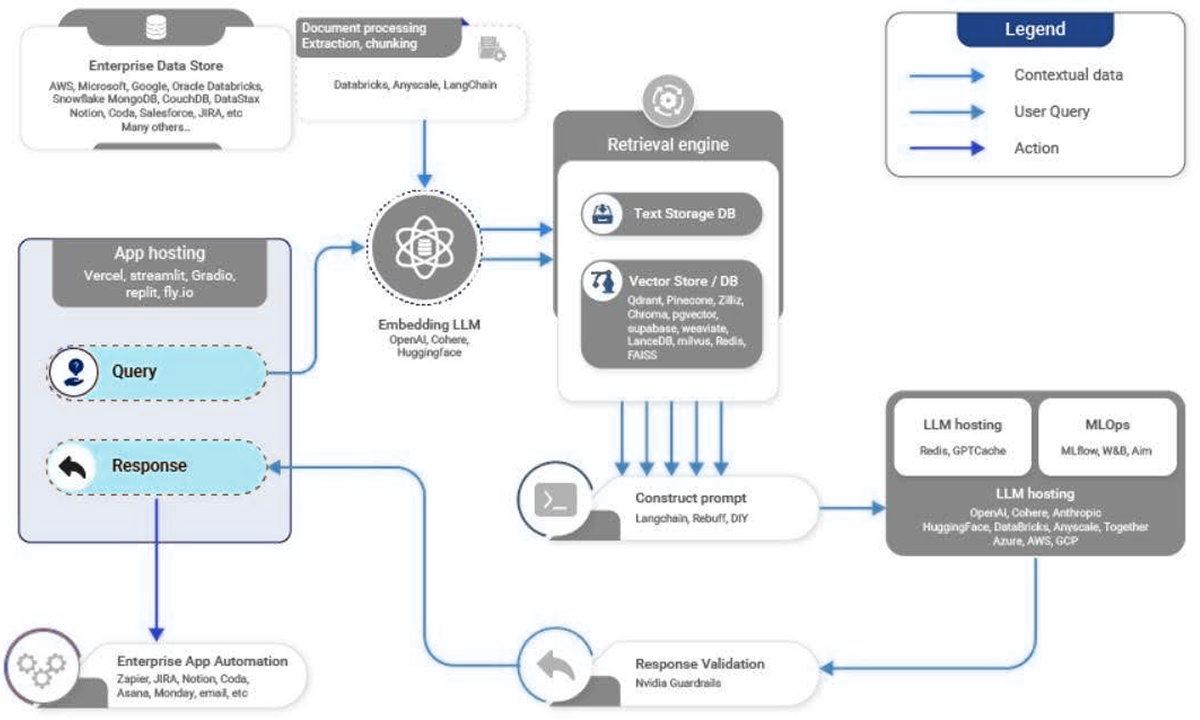
Detailed Execution Flow
1
Document Ingestion
- Documents uploaded from internal systems
- Text extracted and cleaned for processing
- Raw content prepared for downstream steps
2
Chunking & Preprocessing
- Documents split into smaller chunks
- Metadata added — source, type, timestamp
- Chunks structured for embedding generation
3
Embedding Generation
- Each chunk converted to vector representation
- Vectors stored in the vector database
- Semantic search enabled across all content
4
Query Processing
- User enters a natural language query
- Query converted into an embedding
- Embedding prepared for similarity search
5
Retrieval
- Vector similarity search identifies content
- Top-k most relevant documents selected
- Context assembled from retrieved documents
6
Response Generation
- Context and query passed to the LLM
- Response generated with high relevance
- Source references returned with response
Technology Stack
AI & NLP
Large Language Models
Embedding Models
Backend
Python
REST APIs
Data & Storage
Vector Database (Pinecone / FAISS)
Document Storage (S3)
Infrastructure
AWS Lambda
API Gateway
Key Strategic Decisions
Why RAG Instead of Fine-Tuning?
- Avoids need for constant model retraining
- Keeps responses grounded in real data
- More scalable for evolving knowledge bases
Why Serverless Architecture?
- Cost-efficient for variable workloads
- Scales automatically based on usage
- Reduces overall infrastructure overhead
Why Vector Database?
- Enables semantic search over keyword matching
- Improves relevance of retrieved content
- Increases accuracy of generated responses
Scalability & Extensibility
Role-based access for different user types
Multi-source retrieval across documents and databases
Feedback loop for continuously improving responses
Integration-ready with CRM and ERP systems
Business Impact
Operational Efficiency
- 60% reduction in research time
- Faster turnaround on client queries
Decision Quality
- Consistent and accurate responses
- Reduced reliance on individual expertise
Scalability
- Easily extendable to new datasets
- Reusable AI framework for other use cases
User Experience
- Natural language interface for users
- Intuitive and accessible knowledge access


