

High-end jewelry brand scaling online
JEWELRY E-COMMERCE TRANSFORMATION
From Fragmented Storefronts to a Unified, Scalable Commerce Platform
Executive Summary
A high-end jewelry business scaling across direct-to-consumer and wholesale channels transformed its disconnected storefront, ERP, and order systems into a unified commerce platform. By building a real-time integration backbone, the organization eliminated inventory mismatches, automated order workflows, and enabled confident, friction-free scaling across both B2C and B2B channels.
Client Context

Separate B2C and B2B storefronts

Inventory and orders managed in silos

Systems not connected or synchronized
The business needed a unified commerce backbone to support growing digital demand across retail and wholesale channels.
Business Problem
- Operational Challenges
- Products shown available but out of stock
- Orders needed manual validation before fulfillment
- Wholesale and retail pricing managed separately
- Teams reconciling data across systems daily
- Technology Gaps
- No real-time sync between storefront and ERP
- Missing integration between orders and fulfillment
- ERP not built for API-driven commerce workflows
- No unified system for both B2C and B2B
- Business Impact
- Inventory mismatches damaged trust and brand
- Manual processes introduced revenue risk
- Scaling online required significant manual effort
- Leadership hesitant to grow without system confidence
Solution Overview
- STOREFRONT LAYER — Customer-Facing Commerce
- Unified B2C and B2B storefronts on a single platform
- Real-time inventory reflected directly from ERP source
- Separate pricing and workflows configured per channel
- Consistent, trustworthy product availability across all touchpoints
- INTEGRATION LAYER — Commerce Backbone
- Lightweight middleware handling data transformation and validation
- Near real-time sync between storefront and ERP system
- Error handling and conflict resolution built into the layer
- Central control point for all commerce data flow
- ERP CONNECTIVITY — Source of Truth
- ERP serves as single source for inventory and pricing
- Abstraction layers built to handle ERP API constraints
- Product updates in ERP instantly reflected on storefront
- Transformation logic ensures stability under real load
- ORDER MANAGEMENT — End-to-End Order Lifecycle
- Online orders pushed immediately into ERP for fulfillment
- Full order trackability and auditability across systems
- Consistent order state maintained across all channels
- No manual intervention required post-order placement
Architecture Overview
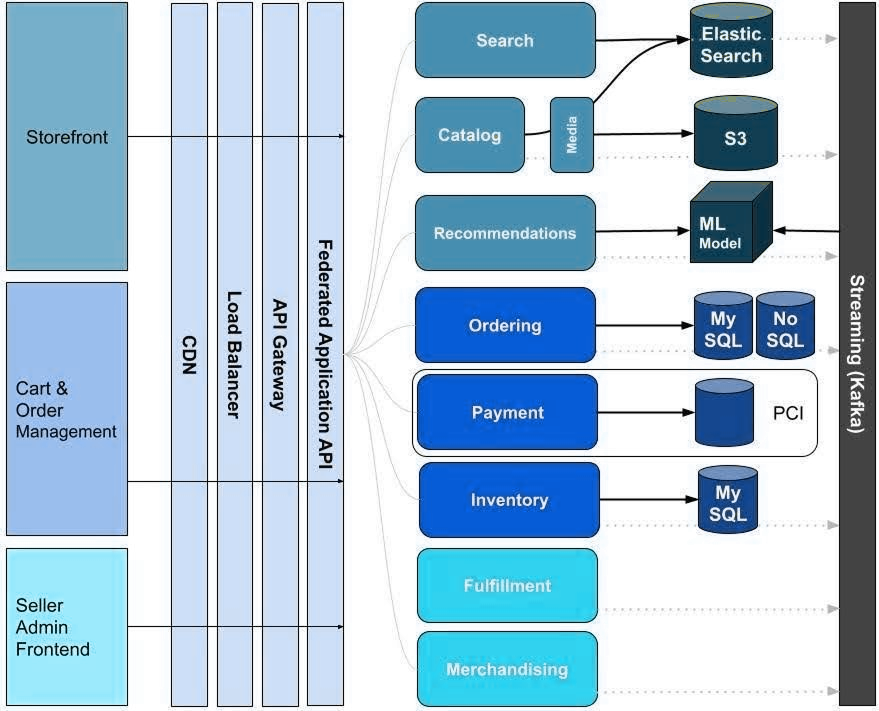
Detailed Execution Flow
1
Product & Inventory Sync
- ERP updates pushed to storefront in near real time
- Inventory accuracy maintained across all channels
- Conflict handling for simultaneous orders built in
2
Storefront Display
- Real-time product availability shown to customers
- B2C and B2B pricing rendered per customer type
- No manual refresh or batch update cycles needed
3
Order Placement
- Customer places order on B2C or B2B storefront
- Order validated instantly against live ERP inventory
- Confirmation triggered only on successful validation
4
Integration Processing
- Integration layer transforms and routes order data
- Validation and error handling applied before ERP push
- Acts as control point between storefront and backend
5
ERP Fulfillment
- Validated order pushed directly into ERP system
- Fulfillment workflow triggered automatically on receipt
- Order status updated and synced back to storefront
6
Ops & Reporting
- Full order lifecycle visible and auditable across systems
- Teams operate without manual reconciliation overhead
- Business scales without adding operational headcount
Technology Stack
Storefront
Shopify
Custom Frontend
Liquid Templating
Integration
Node.js
REST APIs
Custom Middleware Layer
ERP Connectivity
ERP API Connectors
Data Transformation Logic
Webhook Handlers
Payments & Security
Secure Payment Gateway
SSL/TLS
PCI-DSS Compliance
Key Strategic Decisions
Why Real-Time Sync over Batch?
- High-value inventory can't afford delays
- Batch updates cause stock mismatches
- Real-time sync keeps storefront accurate
Why Custom Integration Layer?
- ERP not built for API-driven commerce
- Middleware handles transformation & validation
- Creates a stable, controllable data flow
Why Unified B2C + B2B Platform?
- Same catalog, two distinct buyer types
- One backbone for pricing and workflows
- Reduces overhead and system duplication
Scalability & Extensibility
Platform supports new channel additions without re-architecture
New product collections launch without integration rework
Modular middleware layer allows new ERP connectors easily
Wholesale and retail operations scale independently on same backbone
Business Impact
Operational Efficiency
- Manual reconciliation eliminated
- Orders auto-flow to fulfillment
Inventory Confidence
- Accurate inventory across channels
- No stock-display mismatches
Revenue Enablement
- Faster collection launches
- Higher volume, same headcount
Scalability
- Expands to new channels easily
- Supports retail and wholesale growth


