AI insurance claims processing uses artificial intelligence, machine learning, document intelligence, and workflow automation to streamline activities such as claim intake, document review, data validation, and claims routing.
AI Insurance Claims Processing: Which Tasks Can AI Automate?
Listen to this article
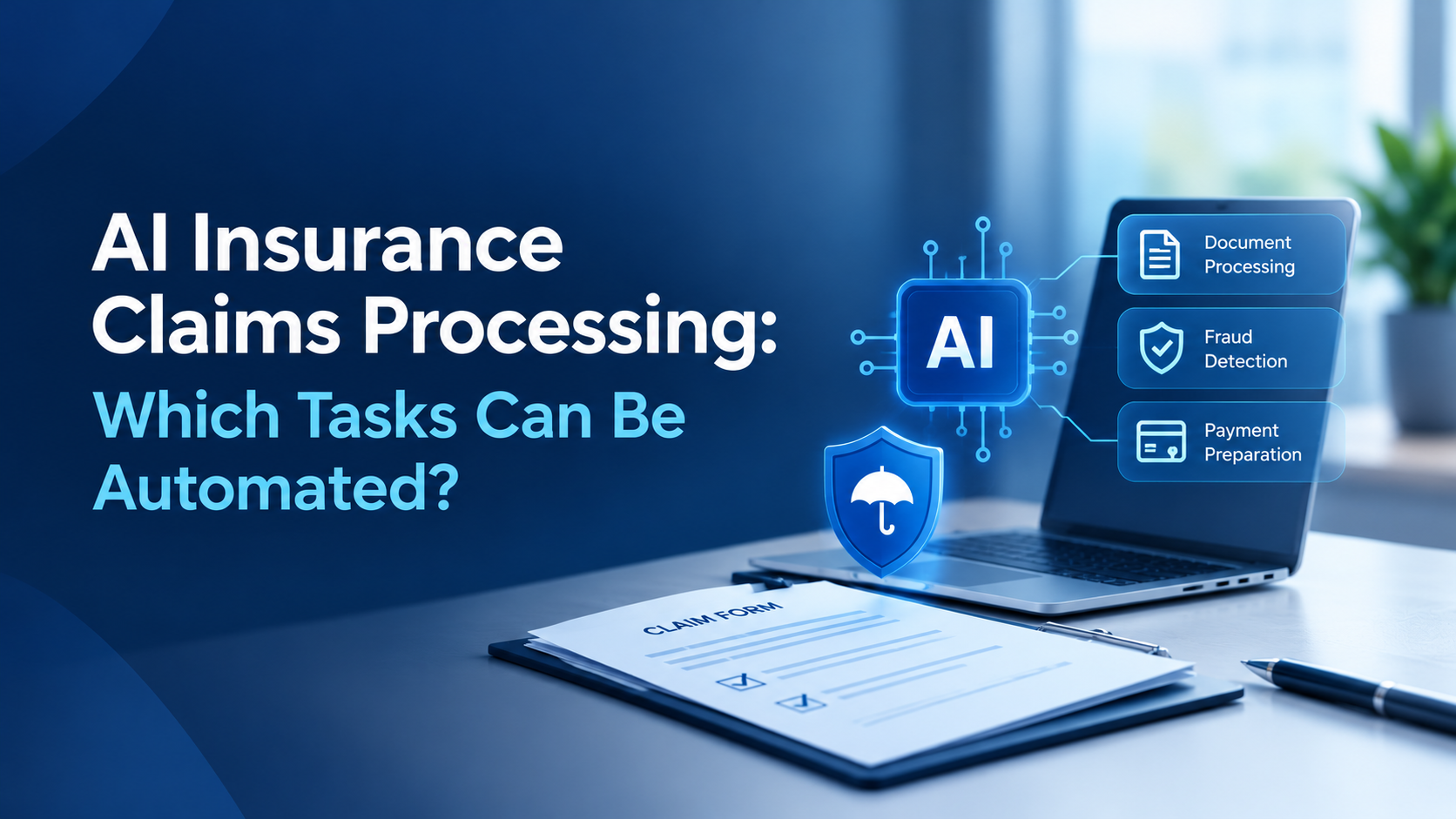
Insurance claims processing involves collecting information, reviewing documents, checking policy details, assessing losses, and coordinating payments. For many insurers, these activities still require employees to move between emails, PDFs, spreadsheets, images, and claims management systems.
As claim volumes grow, manual processes can slow down settlements, increase administrative workloads, and make it harder to deliver a smooth customer experience.
AI insurance claims processing can help automate repetitive tasks, extract information from documents, identify unusual patterns, and route claims to the right teams. But not every claim should be handled automatically. Complex cases, disputed claims, and decisions with significant financial or legal consequences may require human review.
So, which insurance claims tasks can AI automate, and where should people remain involved?
Table of Contents
What Is AI Insurance Claims Processing?
AI insurance claims processing uses artificial intelligence, machine learning, document intelligence, and workflow automation to handle repetitive activities throughout the claims lifecycle.
Traditional claims processing often involves manually collecting information, checking documents, entering data, reviewing evidence, and updating systems. AI can assist with these tasks by extracting relevant information, identifying inconsistencies, summarizing claim details, and recommending the next step.
Depending on the insurer's systems and workflows, AI can support:
- First notice of loss (FNOL) intake
- Claim classification and triage
- Document data extraction
- Policy information checks
- Damage assessment support
- Fraud detection
- Claims status updates
- Payment preparation
- Subrogation identification
- Claims reporting and analysis
The objective is to reduce repetitive administrative work while helping claims professionals make informed decisions.
Which Insurance Claims Tasks Can AI Automate?
The level of automation depends on the claim type, data quality, business rules, and potential impact of an error. Here are the main tasks insurers can consider automating.
1. First Notice of Loss (FNOL) Intake
First notice of loss is the initial report an insurer receives when a customer reports an incident.
Claimants may submit information through online forms, phone calls, emails, or mobile applications. Collecting and organizing this information manually can delay the next stage of processing.
AI can help by:
- Collecting incident details through digital conversations
- Extracting information from submitted forms
- Identifying the type of claim
- Checking whether essential details are missing
- Creating an initial claim record
- Sending incomplete reports for follow-up
For example, after a vehicle accident, an AI-enabled intake system could collect the incident date, location, vehicle details, and a description of the damage. It could then organize the information for the claims team.
Human support should remain available when the claimant needs assistance or the incident is complex.
2. Claim Classification and Triage
Not every claim requires the same level of investigation.
AI can classify claims based on their type, reported severity, available evidence, and predefined business rules. It can then help route them to the appropriate queue.
For example, a straightforward claim with complete documentation may be routed for standard processing, while a high-value property claim may require a specialist adjuster.
Effective triage helps teams prioritize their workload and identify claims that need earlier attention.
AI recommendations should be checked against approved routing rules and monitored for classification errors.
3. Insurance Document Processing
Claims often involve multiple documents, including claim forms, invoices, repair estimates, medical bills, police reports, photographs, and supporting records.
Document intelligence can extract relevant information from these files and convert it into structured data.
Common fields include:
- Claim number and policy number
- Claimant details
- Incident date
- Reported loss amount
- Invoice details
- Repair costs
- Medical billing information
- Supporting evidence references
The extracted information can then be transferred to a claims management system or presented for verification.
For example, AI can extract line items from a repair estimate and compare them with information already recorded in the claim file. If amounts or dates do not match, the system can flag the discrepancy for review.
This reduces manual data entry while making it easier to identify incomplete or inconsistent records.
4. Policy and Coverage Information Checks
Before a claim can be evaluated, the insurer needs to establish the relevant policy details and coverage conditions.
AI-enabled workflows can retrieve policy information and organize details such as policy dates, coverage limits, deductibles, and relevant exclusions for review.
Automated rules can also flag potential issues, such as a reported incident date that falls outside the recorded policy period.
However, identifying a potential coverage issue is not the same as making a final coverage determination. Policy wording, endorsements, exceptions, and applicable laws can require professional interpretation.
AI should support the review process without independently making consequential coverage decisions unless the process is specifically authorized, validated, and appropriately governed.
5. Claims Data Validation
Incomplete or inconsistent information can create unnecessary delays.
AI can compare information across claim forms, policy records, invoices, and other documents to identify missing fields or conflicting details.
For example, a claim might contain different incident dates in the initial report and a supporting document. The system can flag the discrepancy before the claim moves further through the workflow.
Automation can also check whether required documents have been submitted and whether key fields meet predefined validation rules.
This helps claims teams resolve data issues earlier instead of discovering them during later reviews.
6. Damage Assessment Support
Computer vision can analyze photographs and other visual evidence to help assess certain types of damage.
In auto insurance, AI may identify visible vehicle damage, classify damaged areas, and assist with repair estimate preparation. In property insurance, image analysis may help identify visible damage to roofs, walls, or other structures.
These capabilities can support:
- Damage classification
- Image organization
- Initial severity estimates
- Comparison of photographs
- Identification of missing visual evidence
- Preparation of assessment summaries
For example, a claimant may upload photographs of a damaged vehicle. AI can help identify visible damage and organize the images for an adjuster.
Photographs do not always reveal hidden damage, the cause of an incident, or the full repair requirements. Complex cases should be reviewed by qualified professionals.
7. Fraud Detection and Anomaly Identification
AI can analyze claims data to identify unusual patterns that may warrant further investigation.
Depending on the available data and model design, it may flag:
- Unusual claim amounts
- Inconsistent incident details
- Repeated patterns across related claims
- Potential duplicate submissions
- Suspicious timing or transaction patterns
- Differences between reported losses and supporting evidence
For example, a system may identify multiple claims with overlapping details that require further examination.
A fraud alert is not proof of fraud. Automated risk scores can produce false positives, so suspicious claims should be investigated using appropriate evidence and established procedures.
8. Customer Communication and Status Updates
Claimants frequently contact insurers to ask about claim progress, missing documents, or the next steps.
AI assistants and workflow automation can help answer routine questions using approved claim information.
Possible tasks include:
- Confirming that a claim has been received
- Explaining which documents are missing
- Providing approved status updates
- Sending reminders
- Answering common process questions
- Directing complex inquiries to a claims representative
For example, when a claim is waiting for a repair estimate, an automated system can notify the claimant that additional information is required.
Customer-facing AI should use current, authorized information and clearly route complaints, disputes, and sensitive questions to human representatives.
9. Payment Preparation and Processing Support
Once a claim has received the required approvals, automation can help prepare payment-related information.
Tasks may include checking approved amounts, validating payment details, preparing payment instructions, and updating the claim record.
AI can also help flag discrepancies between approved settlements and payment records.
For example, an automated workflow could compare an approved repair amount with the amount prepared for payment and flag a mismatch before the transaction proceeds.
Actual payment release should follow the insurer's authorization controls, segregation of duties, and fraud-prevention procedures. AI should not bypass these safeguards.
10. Subrogation Identification
Subrogation involves recovering claim costs from another party that may be responsible for the loss.
AI can review claim narratives, incident reports, supporting documents, and other available information to identify possible recovery opportunities.
It may flag cases involving another driver, a potentially responsible contractor, or another party whose actions contributed to the loss.
The system can then organize supporting evidence for a recovery specialist.
AI can help identify potential opportunities, but determining liability and pursuing recovery may require legal, contractual, and factual review.
11. Claims Reporting and Analytics
Claims teams need reliable information to understand performance, identify bottlenecks, and manage workloads.
AI and analytics tools can help organize claims data and generate reports on:
- Average processing time
- Claim volumes by type
- Outstanding claims
- Common reasons for delays
- Document-related errors
- Escalation rates
- Settlement trends
- Workload distribution
These insights can help managers identify where processes need improvement and which tasks may benefit most from further automation.
Reports should be based on validated data, with clear definitions for each metric.
How AI Claims Processing Works
AI claims automation typically combines document processing, data validation, business rules, machine learning, and workflow integration.
Step 1: Collect Claim Information
The system receives the initial report, forms, images, invoices, and other supporting documents.
Step 2: Extract and Organize Data
AI identifies relevant information and converts it into structured fields. Validation rules flag missing or inconsistent details.
Step 3: Evaluate and Route the Claim
The workflow checks applicable business rules and may use AI to classify the claim, identify potential issues, or recommend the next action.
Step 4: Request Missing Information
If required details are missing, automation can prepare a request or notify the claimant through an approved communication channel.
Step 5: Review and Approve
Claims that meet the insurer's approved criteria may proceed through established automated workflows. Complex, uncertain, high-value, or potentially suspicious cases are routed for human review.
Step 6: Complete and Record the Outcome
After the necessary approvals, the system can help prepare payment, update claim records, and retain the information needed for monitoring and audit purposes.
Benefits of AI Claims Automation
Faster Claims Processing
Automating repetitive activities can reduce delays caused by manual data entry, document sorting, and routine validation.
Reduced Administrative Work
Claims professionals can spend less time transferring information between systems and more time resolving complex cases.
More Consistent Data Handling
Standardized extraction and validation can help reduce avoidable errors, although results depend on document quality and system performance.
Improved Customer Experience
Timely acknowledgments, clearer document requests, and more consistent status updates can make the claims process easier to navigate.
Better Workload Management
Automated classification and routing can help teams prioritize cases and identify bottlenecks.
Greater Operational Visibility
Reporting tools can give managers a clearer view of claim volumes, processing times, exceptions, and recurring problems.
Actual improvements vary by insurer, claim type, and implementation quality. Organizations should measure results against their existing performance rather than assume a fixed percentage of savings.
What Should Not Be Fully Automated?
AI can assist with many claims tasks, but some decisions require careful judgment and accountability.
Human review is particularly important for:
- Disputed coverage decisions
- Complex liability assessments
- High-value or catastrophic claims
- Claims involving serious injuries
- Potential fraud investigations
- Conflicting or unreliable evidence
- Significant settlement decisions
- Denials or other consequential claim outcomes
The appropriate level of automation depends on the claim, the quality of the available evidence, applicable laws, and the insurer's approved procedures.
A practical approach is to automate repetitive administrative work while keeping clear approval and escalation points for decisions with significant consequences.
Challenges of AI Claims Processing
Poor Data Quality
Incomplete forms, unclear photographs, and inconsistent records can reduce automation accuracy.
Legacy System Integration
Claims information may be spread across policy administration platforms, document repositories, payment systems, and customer service tools. Connecting these systems requires careful planning.
Privacy and Data Security
Claims can contain sensitive personal, financial, medical, and business information. Access controls, secure data handling, retention policies, and vendor reviews are essential.
Accuracy and Explainability
Claims teams need to understand why a system flagged a claim or recommended an action. Outputs should be traceable to supporting evidence wherever possible.
Bias and Regulatory Compliance
AI systems can produce unfair or inaccurate outcomes if their data, design, or use is not properly controlled. Insurers need appropriate testing, monitoring, documentation, and human oversight.
How to Implement AI Claims Automation
1. Review the Current Claims Workflow
Map the process from initial notification to claim closure. Identify repetitive tasks, common delays, and manual handoffs.
2. Select a Practical Starting Point
Begin with a well-defined task such as document classification, data extraction, completeness checks, or customer status notifications.
3. Assess Data and Systems
Review data quality, system integrations, security requirements, and the rules that govern the selected workflow.
4. Establish Human Review Rules
Define which tasks can be automated, which require approval, and which must be escalated.
5. Run a Controlled Pilot
Test the workflow using representative historical or appropriately controlled claims. Compare automated results with verified outcomes before expanding the solution.
6. Monitor and Improve
Track errors, exceptions, processing time, user feedback, and customer outcomes. Update the system as processes and requirements change.
How to Measure AI Claims Processing Success
Useful performance metrics include:
- Claims cycle time: Time from claim notification to completion.
- Data extraction accuracy: Percentage of extracted fields that match verified source information.
- First-pass completeness: Percentage of claims submitted with the required information.
- Manual handling rate: Percentage of claims that require manual intervention.
- Exception rate: Percentage of cases flagged for correction or escalation.
- Customer response time: Time taken to answer claim-related questions.
- Fraud alert quality: How often alerts lead to substantiated findings, assessed alongside false positives.
- Processing cost: Cost per claim compared with the established baseline.
- Quality and compliance: Whether claims are handled accurately and according to applicable requirements.
Faster processing alone is not enough. Insurers should also track incorrect payments, inappropriate denials, customer complaints, and other quality indicators.
Conclusion
AI insurance claims processing can automate many repetitive tasks, including claim intake, document extraction, data validation, claim classification, damage assessment support, fraud screening, customer communication, and payment preparation.
The strongest use cases are often those that reduce administrative work and help claims teams access accurate information sooner.
However, AI should not replace professional judgment in every situation. Complex claims, disputed decisions, potential fraud, and consequential settlement outcomes need appropriate human oversight and clear accountability.
By starting with a focused workflow, validating results, and monitoring both efficiency and quality, insurers can identify where AI offers practical value and expand automation responsibly.
Ready to take the next step?
Frequently Asked Questions
AI can assist with first notice of loss, claim classification, document processing, data validation, fraud screening, damage assessment support, customer updates, payment preparation, and claims reporting.
Some insurers may automate eligible, low-complexity claims under approved rules and controls. Complex, disputed, or high-impact claims generally require appropriate human review.
AI can extract relevant information from claim forms, invoices, repair estimates, reports, and other documents. It can also identify missing fields and inconsistencies for review.
AI can identify unusual patterns and potential fraud indicators in claims data. These alerts require investigation because an anomaly does not automatically prove fraud.
Common challenges include poor data quality, legacy system integration, privacy risks, inaccurate outputs, bias, explainability, and regulatory compliance.
Insurers can compare processing time, manual handling, cost per claim, data accuracy, exception rates, customer experience, and quality outcomes before and after implementation.