AI reduces costs by automating repetitive activities such as document classification, data extraction, validation, data entry, and workflow routing. This reduces manual processing time, increases employee capacity, and can reduce the need for additional administrative resources as document volumes grow.
AI Insurance Document Processing: Cut Costs by 70%
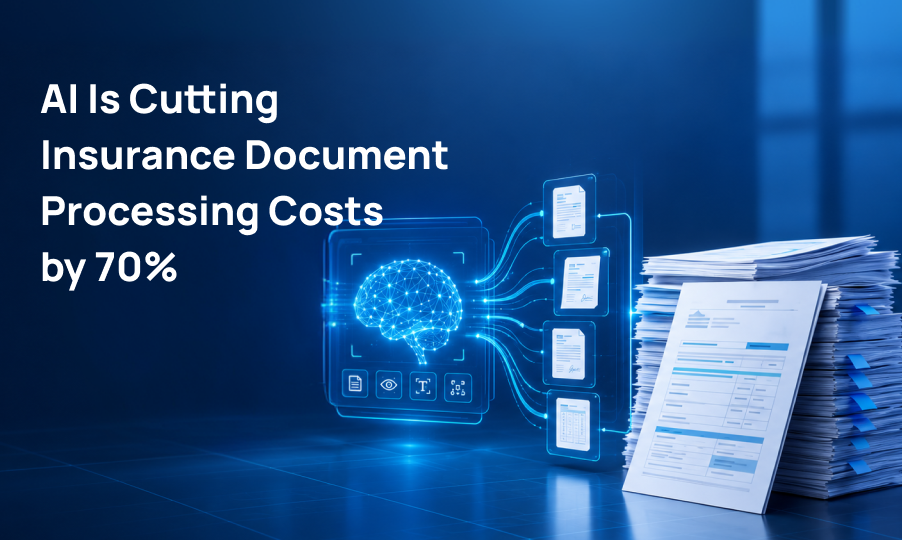
Table of Contents
- Why Insurance Document Processing Is So Expensive
- How AI Is Transforming Insurance Document Intake
- Key Insurance Use Cases for AI Document Processing
- How AI Document Processing Can Reduce Costs by 70%
- Overcoming AI Implementation Challenges
- Building an AI-Powered Insurance Document Workflow
- The Future of Insurance Document Processing
- Conclusion: From Document Processing to Intelligent Insurance Operations
Insurance companies process an enormous volume of documents every day. Claims forms, medical records, police reports, repair estimates, policy applications, invoices, financial statements, and correspondence all contain information that must be reviewed and entered into business systems.
For years, much of this work has depended on manual data entry and basic optical character recognition (OCR). While these approaches can digitize documents, they often struggle to understand context, identify relevant information, or make decisions based on what a document actually contains.
This is where AI-powered document processing is changing the economics of insurance operations.
Modern Intelligent Document Processing (IDP) can classify documents, extract relevant information, validate data, identify exceptions, and route information into downstream systems automatically. When implemented effectively, these capabilities can help insurers significantly reduce the labor and operational costs associated with document-heavy workflows with some organizations targeting reductions of up to 70% in processing costs.
More importantly, AI isn't simply making document processing faster. It is changing how insurance organizations handle information from the moment a document arrives to the moment a decision is made.
Why Insurance Document Processing Is So Expensive
Insurance workflows are inherently document-heavy.
A single claim can involve dozens of documents, including:
- First-notice-of-loss (FNOL) forms
- Insurance policy documents
- Medical records
- Police reports
- Photographs and repair estimates
- Invoices and receipts
- Witness statements
- Correspondence
- Supporting financial documents
Traditionally, employees have had to open these documents, identify important information, manually enter data into insurance systems, compare information across documents, and escalate unusual cases for review.
The problem isn't simply the number of documents.
It is the variation in document formats and the complexity of the information inside them.
A standardized form is relatively easy to process. A multi-page police report containing narrative text, tables, dates, names, and handwritten notes is much more difficult.
The Manual Intake Trap
Manual processing creates several operational problems:
- Higher labor costs: Employees spend significant amounts of time performing repetitive document review and data-entry tasks.
- Longer processing times: Claims and applications cannot move forward until documents have been reviewed and information has been entered.
- Higher error rates: Manual data entry can introduce incorrect policy numbers, dates, amounts, names, and other critical information.
- Limited scalability: Processing more claims often requires adding more employees.
- Customer frustration: Slow claims processing can negatively affect the policyholder experience.
This creates a cycle in which insurers spend heavily simply moving information from documents into business systems.
AI-powered document automation aims to break that cycle.
How AI Is Transforming Insurance Document Intake
Traditional OCR answers a relatively simple question:
"What characters are on this page?"
AI-powered Intelligent Document Processing asks a much more useful question:
"What does this document mean, and what information should the insurance workflow do with it?"
That difference is significant.
Intelligent Document Processing Goes Beyond OCR
Intelligent Document Processing combines technologies such as:
- OCR
- Machine learning
- Natural language processing
- Computer vision
- Document classification
- Large language models
- Rules-based validation
- Workflow automation
Instead of simply converting an image into text, an IDP platform can identify the document type, locate relevant fields, understand relationships between pieces of information, and send structured data to another system.
For example, an AI system processing an auto insurance repair estimate could identify:
- Claim number
- Vehicle identification number
- Vehicle make and model
- Repair shop
- Parts costs
- Labor costs
- Total estimate
- Date of estimate
The resulting information can then be passed into the insurer's claims workflow without requiring an employee to manually enter every field.
Automated Data Extraction
Insurance documents are rarely uniform.
AI document processing can be designed to handle information from structured, semi-structured, and unstructured documents.
This includes extracting information from:
- PDFs
- Scanned documents
- Emails and attachments
- Tables
- Forms
- Medical documentation
- Police reports
- Invoices
- Financial statements
- Handwritten information
The goal is not simply extraction. The system should also determine whether the extracted information is reliable enough to continue automatically.
Cross-Referencing and Validation
Extraction is only one part of the workflow.
AI can also help validate information against existing business rules and data sources.
For example, an automated workflow could compare extracted policy information against the insurer's policy administration system and determine whether:
- The policy exists
- The policy is active
- The claimant information matches
- The claim falls within coverage dates
- Required documentation has been submitted
- Important information is missing
Instead of employees manually performing every check, AI can automate routine validation and send exceptions to human reviewers.
Key Insurance Use Cases for AI Document Processing
AI document automation can affect multiple areas of the insurance value chain.
Claims Intake and FNOL Automation
Claims processing is one of the strongest use cases for document automation.
The first-notice-of-loss process can involve multiple documents and data sources. Traditionally, employees review incoming information and manually enter relevant details into claims systems.
AI can automate significant portions of this process.
A typical workflow could look like:
Document received → Document classified → Data extracted → Information validated → Policy checked → Claim created/updated → Exception routed to employee
For straightforward claims, this can support Straight-Through Processing (STP).
Instead of requiring an employee to touch every claim, the system can automatically process cases that meet predefined criteria while routing complex cases to human adjusters. The result can be faster claims handling and lower administrative costs.
Underwriting Automation
Underwriters need accurate information to assess risk.
Commercial insurance applications can contain large amounts of information spread across application forms, financial records, loss runs, property information, and supporting documentation. AI can extract relevant underwriting information automatically.
For example, an AI workflow could identify:
- Revenue
- Payroll
- Number of employees
- Business locations
- Industry classification
- Prior claims
- Property characteristics
- Coverage requirements
- Financial information
Instead of manually searching through dozens of pages, an underwriter can receive structured information that is ready for review.
This allows underwriters to spend more time on risk assessment and less time on administrative work.
Fraud Detection
Document automation can also support insurance fraud detection. Fraudulent or suspicious claims may contain inconsistencies across documents.
AI systems can help identify anomalies such as:
- Conflicting dates
- Mismatched names or addresses
- Duplicate documentation
- Inconsistent claim amounts
- Suspicious metadata
- Altered documents
- Repeated supporting documents
- Conflicting information across submitted files
AI does not necessarily replace a dedicated fraud investigation team. Instead, it can act as an additional layer of intelligence that identifies cases requiring closer examination.
This helps investigators focus their attention where it is most valuable.
How AI Document Processing Can Reduce Costs by 70%
The potential for major cost savings comes from more than eliminating data entry. AI changes the economics of document-heavy processes in several ways.
1. Reduce Manual Data Entry
Employees no longer need to manually transfer every field from a document into an insurance system.
2. Reduce Processing Time
Documents can be processed continuously instead of waiting in an employee's queue.
3. Reduce Rework
Automated validation can catch missing or inconsistent information earlier in the process.
4. Increase Employee Capacity
Employees can handle more cases because they spend less time on repetitive administrative activities.
5. Improve Straight-Through Processing
Routine claims and applications can move through predefined workflows with minimal human intervention.
6. Scale Without Matching Headcount Growth
When document volumes increase, AI can process additional workloads without requiring a proportional increase in administrative staff.
However, a 70% reduction should not be treated as a universal guarantee. Actual savings depend on factors such as document volume, workflow complexity, automation rates, exception frequency, integration requirements, and the percentage of work currently performed manually.
For insurers with highly manual, high-volume document processes, the opportunity can nevertheless be substantial.
Overcoming AI Implementation Challenges
Implementing AI document processing isn't simply a matter of installing an OCR tool.
Enterprise insurance environments typically involve complex technology stacks and strict regulatory requirements.
A successful implementation needs to address three major areas.
Legacy System Integration
Many insurers operate a combination of:
- Core policy administration platforms
- Claims management systems
- CRM platforms
- Document management systems
- Custom databases
- Data warehouses
- Workflow platforms
An AI document-processing solution needs to fit into this existing environment.
For example, extracted claim information may need to flow directly into a claims platform or CRM rather than remain inside a separate AI application.
This makes API integration, workflow orchestration, data mapping, and system compatibility critical parts of an implementation strategy.
Human-in-the-Loop Review
AI should not be expected to make every decision automatically.
Insurance contains complex edge cases where human judgment remains essential.
A strong AI workflow therefore includes Human-in-the-Loop (HITL) processes.
For example:
High-confidence document → Automated processing
Low-confidence extraction → Human review
Missing information → Request additional documentation
Potential anomaly → Fraud or claims investigation
This approach allows insurers to automate high-volume routine work while preserving human oversight for complicated cases.
Security and Compliance
Insurance documents can contain highly sensitive personal and financial information.
AI document processing therefore needs to be designed around enterprise security requirements.
Depending on the workflow and jurisdiction, organizations may need to consider requirements and frameworks related to:
- Data encryption
- Access controls
- Audit logging
- Data retention
- Privacy
- HIPAA
- GDPR
- SOC 2
- Regulatory requirements specific to insurance operations
Security should not be treated as an afterthought.
It should be incorporated into the architecture from the beginning.
Building an AI-Powered Insurance Document Workflow
A successful insurance automation project typically starts with the workflow not the technology.
Before implementing AI, organizations should identify where employees spend the most time.
A practical assessment can examine:
Step 1: Identify Document-Heavy Processes
Find workflows involving high document volumes and repetitive manual work.
Step 2: Measure Current Costs
Track:
- Processing time
- Cost per document
- Employee hours
- Error rates
- Exception rates
- Average cycle time
Step 3: Classify Automation Opportunities
Not every process needs complete automation.
Separate workflows into:
- Fully automatable
- AI-assisted
- Human-review required
Step 4: Build the Integration Layer
Connect AI document processing to existing claims, underwriting, CRM, and policy systems.
Step 5: Establish Confidence Thresholds
High-confidence results can be processed automatically, while uncertain results are routed for review.
Step 6: Monitor Performance
Measure automation rates, accuracy, processing time, exception rates, and cost savings continuously.
This creates a feedback loop that allows the system to improve over time.
The Future of Insurance Document Processing
Insurance companies are moving toward increasingly automated workflows.
The next generation of insurance operations will not simply digitize documents. It will transform documents into actionable business information.
Imagine a claim arriving through email.
Instead of an employee manually opening the attachment, identifying the claim number, searching for the policy, entering the information, checking documentation, and forwarding the case, an AI-powered workflow could perform much of this work automatically.
The system could:
- Receive the document.
- Identify its type.
- Extract relevant information.
- Validate the extracted data.
- Match it with the policy.
- Identify missing information.
- Detect potential anomalies.
- Update the relevant system.
- Route exceptions to an employee.
- Maintain an audit trail.
This represents a fundamental shift from document processing to intelligent workflow automation.
The competitive advantage will increasingly come from how quickly insurers can turn incoming information into decisions.
Conclusion: From Document Processing to Intelligent Insurance Operations
Insurance companies cannot eliminate documents from their operations. But they can eliminate much of the manual work associated with processing them.
AI-powered Intelligent Document Processing gives insurers a way to automate document classification, data extraction, validation, routing, and workflow execution.
The biggest opportunity isn't simply saving a few minutes per document.
It is creating an operating model where routine information flows automatically while employees focus on exceptions, judgment, customer service, and higher-value work.
For organizations processing thousands or millions of insurance documents, that shift can potentially deliver dramatic improvements in cost, speed, accuracy, and scalability.
Want to find out where AI could reduce document-processing costs in your insurance workflows?
Wisdom Square Technologies can help assess your existing document processes, identify automation opportunities, and design custom AI-powered document workflows that integrate with your existing technology environment.
Ready to take the next step?
Frequently Asked Questions
Yes. Modern Intelligent Document Processing solutions can work with structured, semi-structured, and unstructured documents, including PDFs, scanned forms, reports, invoices, medical documentation, and other business records. The system can extract relevant information based on the document's context rather than relying only on fixed field locations.
AI can automate significant parts of claims processing, particularly document intake, classification, data extraction, validation, and routing. Straightforward claims can potentially move through automated workflows, while complex or low-confidence cases can be sent to human claims professionals for review.
It can be designed for enterprise-grade security, including encryption, access controls, audit trails, data governance, and appropriate compliance controls. The exact requirements depend on the type of information being processed, the systems involved, and the jurisdictions in which the insurer operates.
AI document processing is generally better positioned as an automation and augmentation technology rather than a complete replacement for employees. It can handle repetitive document-related tasks while human employees focus on complex claims, underwriting decisions, investigations, exceptions, and customer interactions.
Savings vary significantly based on the workflow, document volume, current labor costs, automation rate, and complexity of the process. Some highly manual workflows may achieve substantial cost reductions, potentially approaching 70% in suitable scenarios, but organizations should conduct a workflow-level assessment before assuming a specific savings percentage.