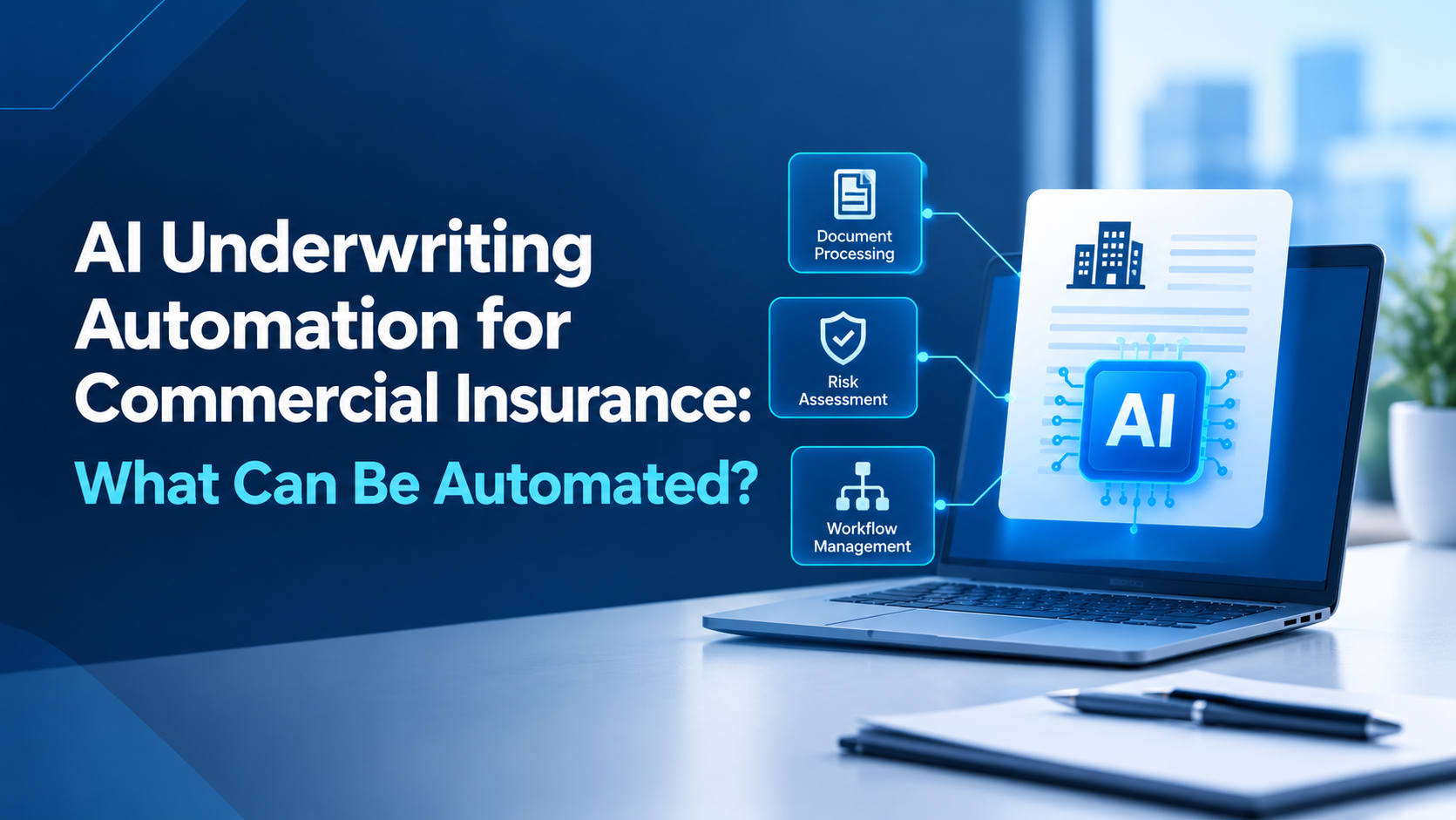
AI underwriting automation uses AI, machine learning, document intelligence, and workflow tools to streamline tasks such as document processing, data validation, risk information gathering, and submission routing.
AI Underwriting Automation in Commercial Insurance: What Can AI Automate?
Listen to this article
Commercial insurance underwriting involves reviewing applications, analyzing risk information, checking documents, and deciding whether a business qualifies for coverage. These tasks often require underwriters to work across emails, PDFs, spreadsheets, loss runs, and multiple business systems.
As submission volumes increase, manual processes can slow down underwriting teams and make it harder to respond to brokers quickly.
AI underwriting automation can help by extracting information from documents, identifying missing details, organizing risk data, and supporting underwriting decisions. However, not every task should be fully automated. Complex risks, exceptions, and important coverage decisions still require qualified human judgment.
So, what can AI actually automate in commercial insurance underwriting? Let's explore the main use cases, benefits, limitations, and implementation steps.
Table of Contents
- What Is AI Underwriting Automation?
- What Can AI Automate in Commercial Insurance Underwriting?
- How AI Underwriting Automation Works
- Benefits of AI Underwriting Automation
- What Should Not Be Fully Automated?
- Challenges of AI Underwriting Automation
- How to Implement AI Underwriting Automation
- How to Measure Underwriting Automation Success
- Is AI Underwriting Automation Right for Your Business?
- Conclusion
- FAQs
What Is AI Underwriting Automation?
AI underwriting automation uses artificial intelligence, machine learning, document intelligence, and workflow automation to handle repetitive tasks within the insurance underwriting process.
Traditional underwriting often requires employees to collect information from different sources, enter data into underwriting systems, check eligibility rules, and prepare files for review.
AI can assist with these activities by turning unstructured information into organized data and routing submissions according to predefined business rules.
For commercial insurers, this can involve:
- Reading broker emails and attachments
- Extracting information from applications and loss runs
- Checking whether required documents are present
- Identifying inconsistencies in submitted information
- Collecting relevant risk data
- Supporting risk classification and assessment
- Routing submissions to the appropriate underwriting team
- Preparing summaries for underwriter review
The goal is not simply to replace manual work with AI. It is to help underwriters spend less time gathering information and more time evaluating risk, managing portfolios, and making informed decisions.
What Can AI Automate in Commercial Insurance Underwriting?
The most practical starting points are tasks that involve large amounts of documents, repetitive data handling, predictable rules, and clearly defined workflows.
Submission Intake and Classification
Commercial insurance submissions can arrive through broker emails, online portals, spreadsheets, and PDF attachments.
AI can identify incoming submissions, classify documents, recognize the type of insurance being requested, and organize information for the next stage of processing.
For example, a submission might include a business insurance application, a loss history report, and supporting financial documents. AI can identify these files and group them under the appropriate submission record.
This reduces manual sorting and helps underwriting teams process incoming requests more consistently.
Document Data Extraction
Underwriters often need to extract information from multiple documents before they can evaluate a risk.
AI-powered document intelligence can capture relevant fields from applications, loss runs, financial statements, property schedules, and other supporting documents.
Depending on the document and workflow, extracted fields may include:
- Business name and address
- Industry and business activities
- Requested coverage
- Revenue and payroll information
- Property details
- Claims history
- Policy dates
- Limits and deductibles
The extracted information can then be transferred to underwriting systems or presented for review.
Human verification remains important when documents are unclear, information conflicts, or extracted values could materially affect a decision.
Missing Information and Data Validation
Incomplete submissions often create delays because underwriters must contact brokers to request additional information.
AI can compare a submission against a checklist of required documents and fields. It can flag missing information, detect inconsistent values, and identify records that need clarification.
For example, a commercial property submission might be missing building details or a required inspection report. The system can flag the gap and help prepare a request for the missing information.
This makes the intake process more organized and can reduce avoidable back-and-forth communication.
Risk Data Enrichment
Commercial risk assessment may require information beyond the initial application.
Depending on the insurance line, AI-enabled workflows can help collect and organize information from approved internal and external data sources.
Examples include:
- Business and industry information
- Property characteristics
- Geographic exposure
- Historical claims information
- Financial indicators
- Relevant risk inspection findings
The system can combine this information into a structured risk profile for the underwriter.
The reliability of this process depends on data quality, source permissions, appropriate validation, and the relevance of the information to the insurance product.
Underwriting Rule Checks and Eligibility Screening
Many insurers use established rules to determine whether a submission meets basic eligibility requirements.
Automation can apply approved rules to check factors such as industry, location, requested coverage, business size, or other product-specific criteria.
For example, a submission that falls outside a carrier's stated appetite may be flagged for referral or routed to a specialist team.
AI can help interpret information and recommend a route, while deterministic rules can handle clearly defined eligibility checks.
Important decisions should follow the insurer's approved underwriting guidelines, with human review for exceptions and uncertain cases.
Risk Scoring and Decision Support
Machine learning models can analyze historical data to identify patterns associated with particular risks or outcomes.
When appropriately designed and validated, these models can help underwriters prioritize submissions, identify potential risk indicators, or compare a submission with relevant historical cases.
AI-generated risk scores should be treated as decision-support information rather than unquestionable answers.
Underwriters need to understand the factors influencing a recommendation, assess whether the data is reliable, and determine whether the result fits the insurer's guidelines and risk appetite.
Pricing Preparation and Rating Support
Pricing commercial insurance can involve multiple variables, rating rules, and supporting data.
AI can help organize the information needed for pricing, identify missing rating fields, and prepare data for an insurer's approved rating engine.
It can also help summarize relevant risk characteristics for underwriter review.
However, pricing authority should remain governed by validated actuarial models, approved rating rules, regulatory requirements, and appropriate human oversight. Generative AI should not independently invent rates or coverage terms.
Submission Routing and Workflow Management
Once a submission has been collected and checked, it needs to reach the right person or team.
Workflow automation can route submissions based on product type, geography, underwriting authority, complexity, workload, or predefined referral criteria.
AI can also summarize case status, identify stalled submissions, and flag outstanding actions.
For example, a routine submission may move to a standard review queue, while a complex risk or an exception is sent to a senior underwriter.
This helps reduce manual coordination and gives teams better visibility into their workload.
Underwriting Summaries and Communication
AI can summarize long applications, loss runs, inspection reports, and other documents into concise review notes.
It can also help draft broker communications, requests for missing information, and internal case updates.
These drafts should be checked before being sent, especially when they involve coverage interpretations, exclusions, pricing, or other consequential information.
Policy Documentation and Renewal Preparation
After underwriting decisions are made, automation can support administrative activities such as preparing documentation, checking policy information for inconsistencies, tracking endorsements, and assembling renewal files.
At renewal, AI can summarize changes in business information, claims history, exposure details, and policy records to help underwriters identify items that need attention.
Final policy terms and documents should still follow the insurer's authorized approval and issuance processes.
How AI Underwriting Automation Works
AI underwriting automation usually combines several technologies rather than relying on one model.
Step 1: Collect Submission Data
The workflow receives applications, emails, PDFs, spreadsheets, and supporting documents from the insurer's existing intake channels.
Step 2: Extract and Structure Information
Document intelligence extracts relevant fields and converts them into structured records. Validation checks identify missing, unclear, or inconsistent values.
Step 3: Enrich and Evaluate the Submission
Approved data sources provide additional context. Business rules and validated models help check eligibility, identify risk indicators, and prepare the submission for review.
Step 4: Route the Case
The workflow directs the submission to the appropriate queue based on its characteristics, completeness, and referral requirements.
Step 5: Review and Make the Decision
An underwriter reviews the relevant evidence, resolves exceptions, and makes decisions according to the insurer's authority and guidelines.
Step 6: Record the Outcome
The system records actions, data sources, model outputs, approvals, and overrides as appropriate. These records support monitoring, quality checks, and auditability.
Benefits of AI Underwriting Automation
When implemented around the right workflows, AI underwriting automation can offer several operational benefits.
Faster Submission Processing
Automating document sorting, data extraction, and completeness checks can reduce the time spent preparing submissions for review.
Less Manual Data Entry
Structured data extraction can reduce repeated copying of information between documents and underwriting systems.
More Consistent Workflows
Standardized validation and routing rules can help teams process similar submissions more consistently.
Better Underwriter Productivity
Underwriters can spend more time evaluating risks, discussing complex cases with brokers, and managing portfolios instead of assembling information manually.
Improved Workflow Visibility
Automated tracking can help managers identify delays, incomplete submissions, and recurring process bottlenecks.
Support for Growing Submission Volumes
Automation can help teams handle higher workloads without requiring every increase in submission volume to result in a proportional increase in administrative work.
Actual results depend on the quality of the data, workflow design, integration effort, and how well the solution fits the insurer's processes. Businesses should measure results rather than assume a specific percentage of work can be automated.
What Should Not Be Fully Automated?
AI can support many underwriting tasks, but commercial insurance involves complex exposures, incomplete evidence, and decisions with financial and legal consequences.
Human oversight is especially important for:
- Complex or unusual commercial risks
- Exceptions to underwriting guidelines
- Uncertain or conflicting data
- Significant pricing or coverage decisions
- High-impact referrals
- Situations requiring professional interpretation
- Decisions involving sensitive or potentially discriminatory data
The appropriate level of automation depends on the insurance product, decision impact, data reliability, applicable regulations, and the insurer's risk appetite.
A practical approach is to automate routine preparation and clearly defined checks while directing uncertain, complex, or high-impact cases to qualified underwriters.
Challenges of AI Underwriting Automation
Poor or Inconsistent Data
Documents may contain outdated, incomplete, or conflicting information. AI cannot reliably correct every underlying data problem without additional evidence and validation.
Legacy System Integration
Underwriting teams may rely on policy administration systems, rating engines, document repositories, and broker platforms that were not designed to work together.
Integration planning is essential to avoid creating another disconnected tool.
Explainability and Auditability
Insurers need to understand how automated recommendations are produced, which information was used, and when a human changed the result.
Privacy and Security
Underwriting documents may contain sensitive business, financial, and personal information. Access controls, data protection, retention policies, and vendor security reviews should be part of implementation planning.
Bias and Regulatory Requirements
Models trained on historical data may reproduce existing patterns or create unfair outcomes. Insurers should assess model performance, test for inappropriate disparities, document controls, and review applicable insurance regulations.
The National Association of Insurance Commissioners provides guidance and resources on insurers' use of AI and related governance considerations.
How to Implement AI Underwriting Automation
A phased approach helps insurers start with practical use cases and validate performance before expanding automation.
Map the Existing Underwriting Workflow
Document how submissions move from intake to decision and issuance. Identify repetitive tasks, common delays, manual data entry, and frequent errors.
Choose a Suitable Starting Use Case
Begin with a clearly defined task, such as document classification, data extraction, missing-information checks, or submission routing.
A narrow use case is often easier to test than attempting to automate the entire underwriting lifecycle at once.
Review Data and System Readiness
Check document quality, data access, integration requirements, existing underwriting rules, and system limitations.
Identify what information the AI solution can access and which systems it needs to update.
Define Human Review and Escalation Rules
Determine which tasks can be completed automatically, which require approval, and which must always be referred to a qualified underwriter.
Set clear rules for low-confidence outputs, exceptions, and conflicting information.
Run a Pilot
Test the solution using representative historical or appropriately controlled submissions. Compare the results against established human-reviewed outcomes and investigate errors before expanding use.
Monitor and Improve
Track extraction quality, exception rates, processing time, user feedback, and decision-support performance. Update the workflow as products, data, rules, and regulations change.
How to Measure Underwriting Automation Success
The success of an AI underwriting project should be measured using operational and risk-related outcomes, not simply the number of tasks automated.
Useful metrics include:
- Submission processing time: How long it takes to prepare a submission for review.
- Data extraction accuracy: How often extracted fields match verified source information.
- First-pass completeness: How often submissions contain the required information on initial review.
- Exception rate: How often cases require manual correction or escalation.
- Underwriter productivity: How much time teams spend on administrative work versus risk evaluation.
- Workflow turnaround time: How long submissions remain in each stage.
- Quality and decision outcomes: Whether recommendations and processing meet the insurer's established standards.
- Audit and compliance performance: Whether the process produces the required records and follows applicable controls.
Compare these metrics with a documented baseline before automation. That makes it easier to determine whether the solution is delivering measurable value.
Is AI Underwriting Automation Right for Your Business?
AI underwriting automation may be a good fit for insurers, managing general agents, and commercial underwriting teams that process large volumes of document-heavy submissions or spend significant time collecting and validating information.
It may be especially useful when:
- Submissions arrive in multiple formats.
- Underwriters repeatedly enter the same information.
- Missing documents create frequent delays.
- Teams struggle to track submission status.
- Existing systems require substantial manual coordination.
- Leadership wants to improve workflow visibility and operational efficiency.
However, automation may deliver limited value if the process is already efficient, data quality is poor, or the organization lacks the governance and technical foundations needed to manage AI responsibly.
The best starting point is a workflow assessment that identifies the most repetitive tasks, the business impact of current delays, and the controls needed before automation is introduced.
Conclusion
AI underwriting automation can help commercial insurers streamline submission intake, extract data from documents, validate information, enrich risk profiles, support pricing preparation, route cases, and prepare underwriting summaries.
The greatest opportunity is often in reducing the administrative work that happens before an underwriter makes a decision.
However, AI should not be treated as a substitute for professional judgment across every commercial risk. Reliable data, validated rules, human oversight, explainability, security, and regulatory compliance are essential parts of an effective solution.
By starting with a well-defined workflow, testing performance, and measuring results, insurers can identify where AI delivers practical value and expand automation responsibly.
Ready to take the next step?
Frequently Asked Questions
AI can assist with submission intake, document classification, data extraction, completeness checks, risk data enrichment, eligibility screening, workflow routing, underwriting summaries, and renewal preparation.
AI can support risk assessment and certain predefined decisions, depending on the insurer's rules and controls. Complex, uncertain, or high-impact cases should receive appropriate human review.
AI can reduce manual document review and data entry, organize risk information, flag missing details, and help underwriters focus on risk evaluation and complex cases.
Traditional automation often follows predefined rules to complete repetitive tasks. AI can also interpret documents, identify patterns, summarize information, and support decisions. Many practical systems combine both approaches.
Yes, depending on the workflow and business case. Smaller teams may start with a focused task, such as document extraction or submission completeness checks, rather than automating the entire process.
Insurers can compare processing time, manual effort, data accuracy, exception rates, workflow turnaround, and quality outcomes before and after implementation. Results should be measured against a documented baseline.