AI-driven ERP solutions use artificial intelligence to automate business processes, analyze data, and improve decision-making across different departments.
How AI-Driven ERP Solutions Help Businesses Improve Efficiency
Listen to this article
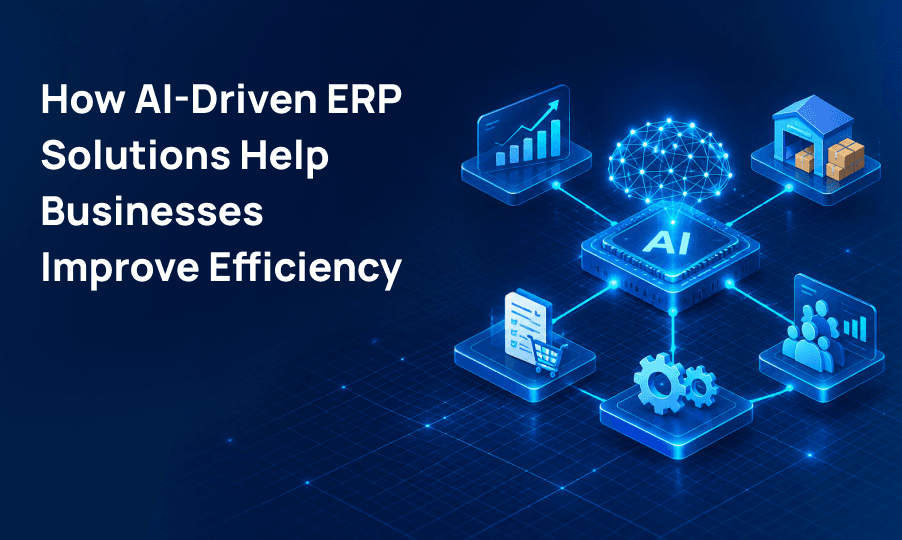
Table of Contents
- Introduction
- What Are AI-Driven ERP Solutions?
- Common Business Challenges and How AI-Driven ERP Solves Them
- Purpose of AI in ERP Systems
- Key Benefits of AI-Driven ERP Solutions
- Challenges of Implementing AI in ERP Systems
- How to Implement AI-Driven ERP Solutions
- Role of AI in Modern ERP Systems
- Market Impact and Future of AI-Driven ERP Solutions
- AI-Driven ERP Solutions with Wisdom Square Technologies
- Conclusion
Introduction
Managing finance, inventory, procurement, and sales across disconnected systems can slow down business operations. Traditional ERP systems organize business information, but often require manual work and lack advanced predictive insights.
AI-driven ERP solutions combine artificial intelligence with ERP systems to automate workflows, analyze business data, improve forecasting, and support faster decision-making. They help businesses simplify operations and use resources more effectively.
What Are AI-Driven ERP Solutions?
AI-driven ERP solutions use artificial intelligence to improve how businesses manage information and daily operations. They combine traditional ERP functions with technologies that analyze data, identify patterns, and automate tasks.
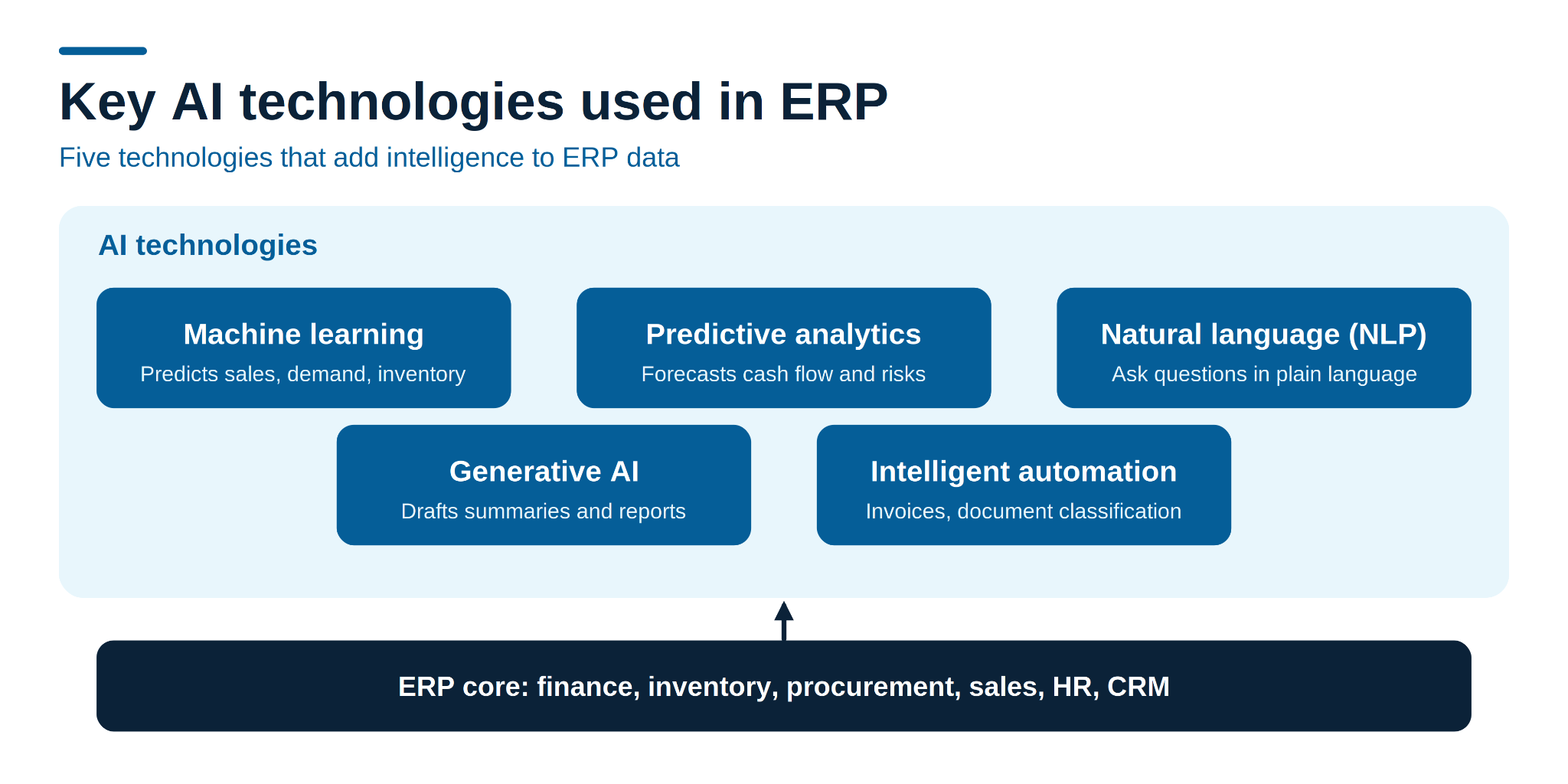
Key AI Technologies Used in ERP
- Machine Learning: Analyzes historical data to predict sales, demand, and inventory requirements.
- Predictive Analytics: Helps businesses forecast cash flow, expenses, and operational risks.
- Natural Language Processing (NLP): Allows employees to ask questions and retrieve ERP information using everyday language.
- Generative AI: Creates business summaries, reports, and responses using available ERP information.
- Intelligent Automation: Automates repetitive activities such as invoice processing and document classification.
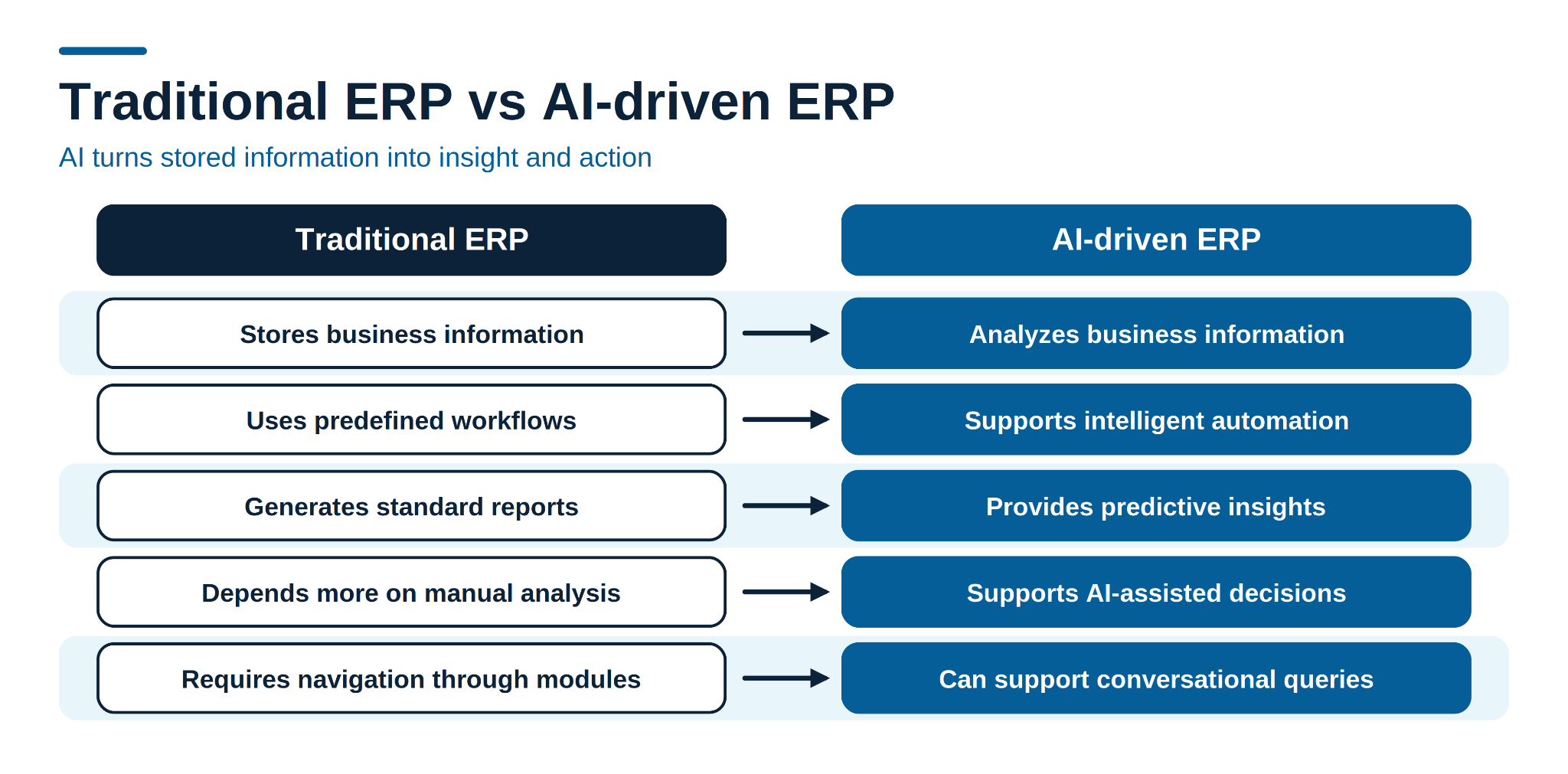
Traditional ERP vs. AI-Driven ERP
RPA vs. Predictive AI vs. Generative AI
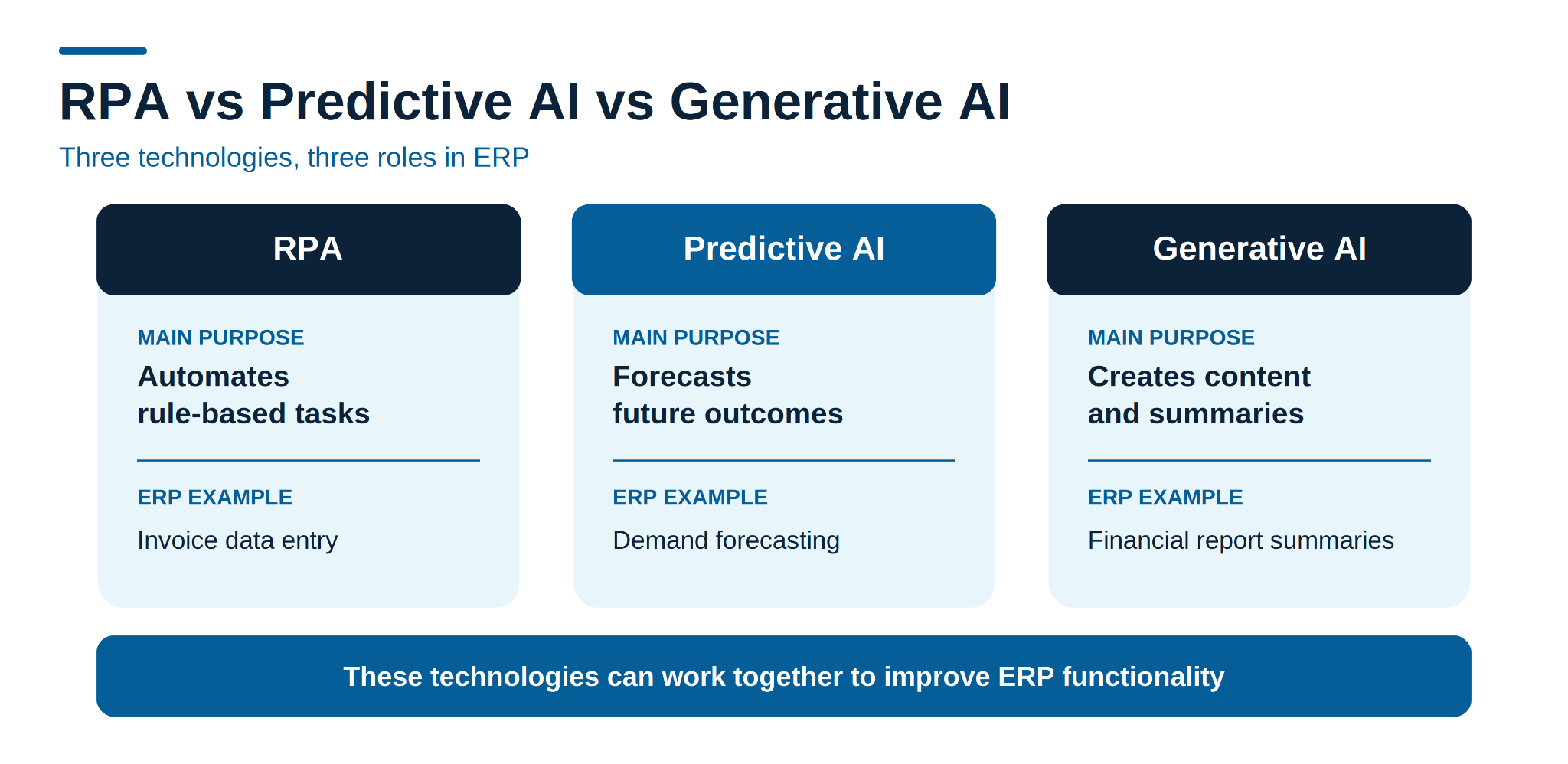
These technologies can work together to improve ERP functionality.
Common Business Challenges and How AI-Driven ERP Solves Them
Businesses often face operational problems that affect productivity and decision-making. AI helps address these challenges.
Manual Tasks
Employees spend time entering data and processing invoices.
AI solution: Automates document extraction, data entry, and repetitive workflows.
Inaccurate Business Data
Manual entries can create duplicate records and incorrect information.
AI solution: Identifies inconsistencies, unusual entries, and potential errors.
Poor Demand Forecasting
Businesses struggle to predict changing customer demand.
AI solution: Analyzes historical sales and seasonal patterns to estimate future demand.
Inventory Management Problems
Overstocking increases storage costs, while shortages delay orders.
AI solution: Analyzes stock levels and sales trends to support inventory planning.
Delayed Decision-Making
Managers often wait for reports from different departments.
AI solution: Provides faster insights through centralized dashboards and AI-generated summaries.
Disconnected Systems
Different departments may use applications that do not communicate properly.
AI solution: AI ERP integration connects business applications and improves information sharing.
Purpose of AI in ERP Systems
The main purpose of artificial intelligence in ERP systems is to make business operations more intelligent and efficient.
Key purposes include:
- Process Automation: Reduces repetitive manual activities.
- Better Forecasting: Helps predict inventory, sales, and financial requirements.
- Operational Visibility: Provides insights across different departments.
- Resource Optimization: Helps businesses manage employees, equipment, and materials.
- Faster Decisions: Summarizes information and highlights important business trends.
AI helps businesses use their ERP data more effectively instead of simply storing information.
Key Benefits of AI-Driven ERP Solutions
AI-driven ERP solutions help businesses improve productivity, reduce manual work, and make better operational decisions.
Improved Operational Efficiency
Automates repetitive activities and helps departments complete tasks faster.
Automated Workflows
Streamlines invoice processing, purchase orders, document handling, and approvals.
Better Business Forecasting
Analyzes historical data and market patterns to support demand and financial planning.
Real-Time Data Insights
Provides updated business information through dashboards, reports, and AI-generated summaries.
Reduced Human Errors
Identifies duplicate records, missing information, and unusual transactions for review.
Smarter Inventory Management
Helps businesses maintain suitable stock levels and avoid unnecessary shortages.
Improved Customer Experience
Connects order, sales, and customer information to help teams respond faster.
Cost and Resource Optimization
Identifies inefficient processes and helps businesses manage operational expenses.
Research insight: A 2026 invoice automation study reported approximately 81% lower effective processing time in its specific prototype compared with manual processing. Results depend on the workflow and implementation, so this should not be treated as a universal business outcome.
Challenges of Implementing AI in ERP Systems
Although AI offers several benefits, businesses should consider the following challenges.
| Challenge | How to Address It |
|---|---|
| Poor data quality | Clean and standardize business data. |
| High implementation costs | Start with high-value AI use cases. |
| Security and privacy | Apply encryption and access controls. |
| Employee adoption | Provide practical training. |
| Legacy system compatibility | Use APIs and suitable integration methods. |
| Ongoing maintenance | Monitor performance and update AI models. |
Proper planning, data governance, and employee involvement help businesses manage these challenges.
How to Implement AI-Driven ERP Solutions
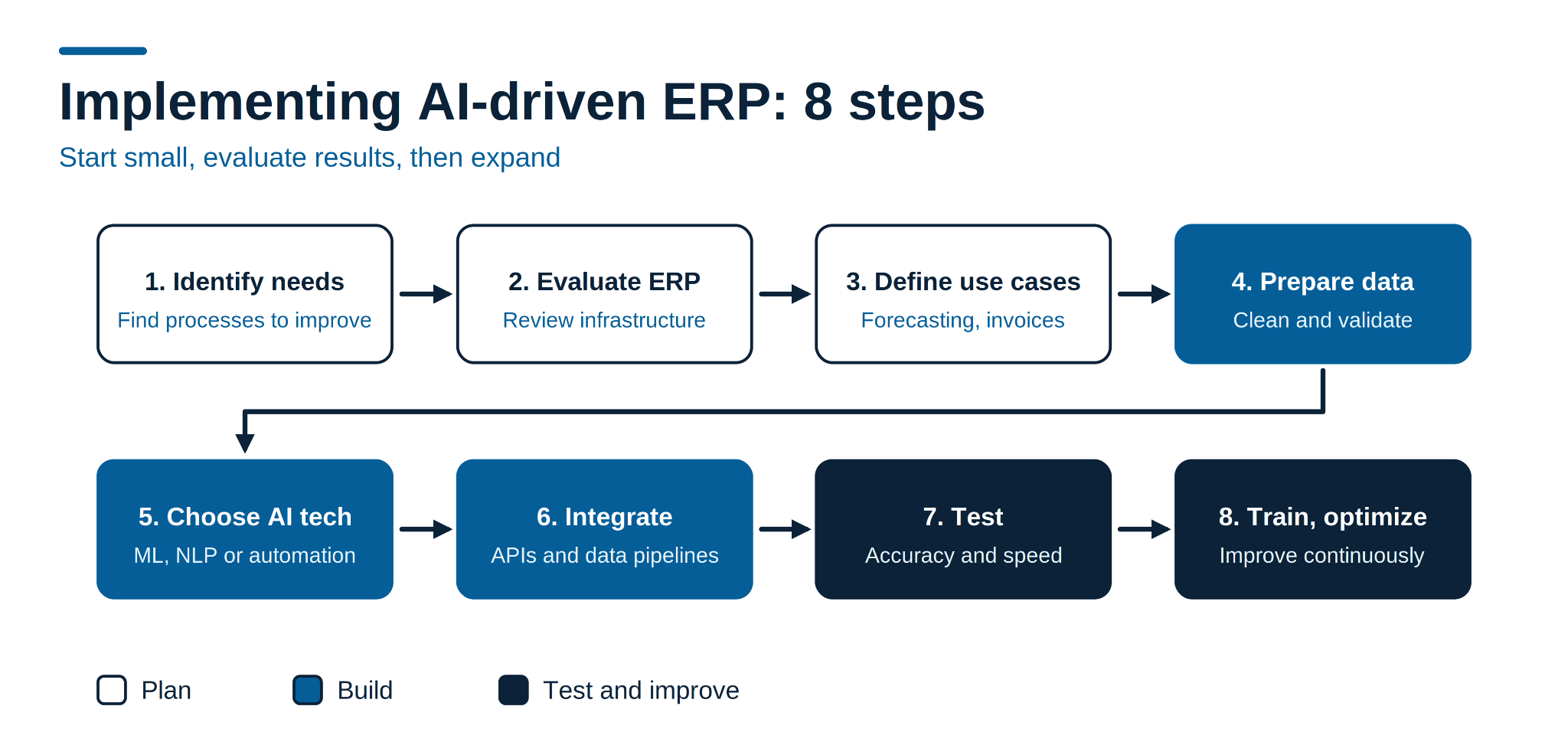
Businesses should follow a structured approach when introducing AI into existing ERP environments.
Starting with smaller projects allows businesses to evaluate results before expanding AI implementation.
Role of AI in Modern ERP Systems
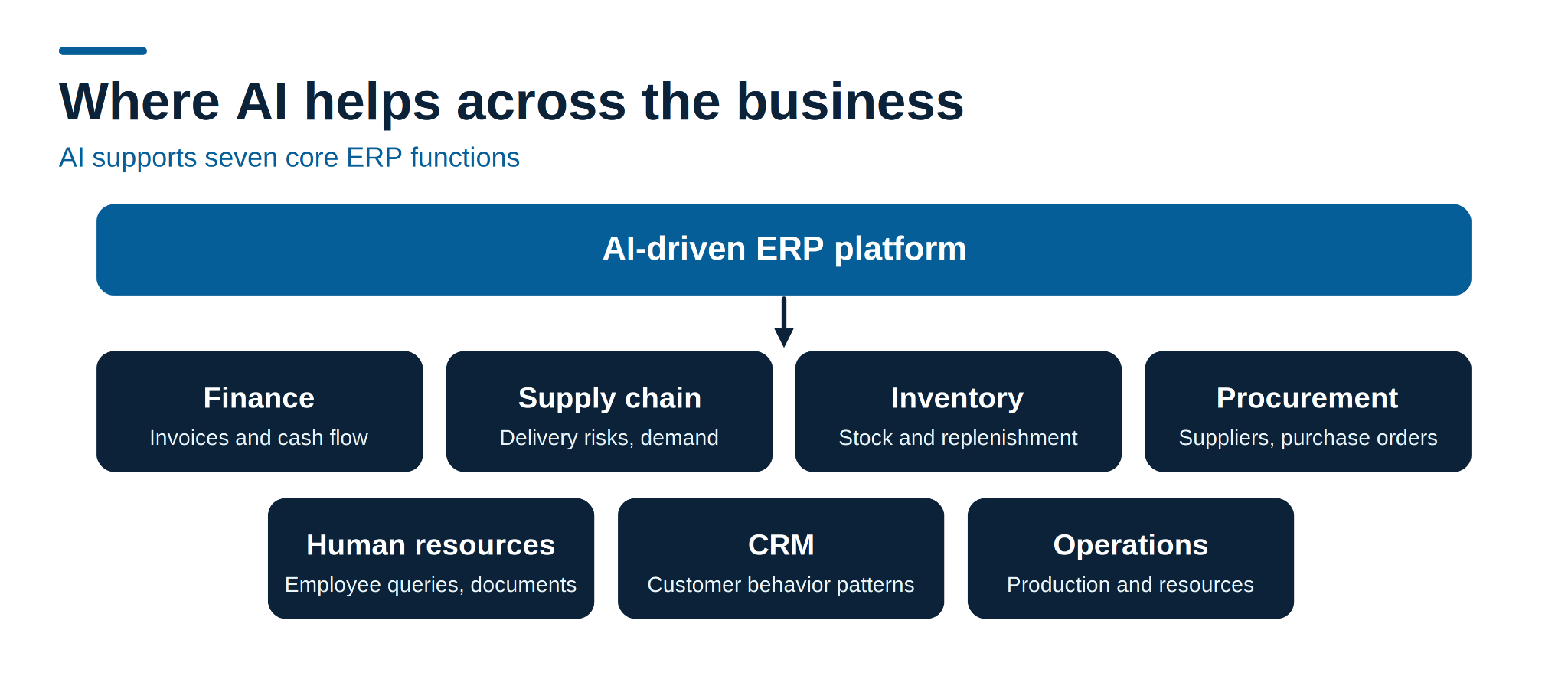
AI supports several business departments by improving information processing and automating selected activities.
These applications help departments work with better information and coordinate business activities more effectively.
Market Impact and Future of AI-Driven ERP Solutions
AI is transforming ERP systems from basic business management platforms into intelligent systems that support automation and decision-making.
Some important developments include:
Predictive Intelligence
AI will help businesses anticipate inventory shortages, cash flow changes, and supply chain disruptions.
Intelligent Automation
Businesses can combine RPA and AI to automate workflows involving multiple applications.
Conversational ERP Interfaces
Employees can ask questions about sales, inventory, and expenses using natural language.
AI-Powered Decision Support
AI can summarize reports, identify trends, and suggest possible actions.
Connected Enterprise Systems
AI integration across ERP, CRM, finance, and supply chain applications will support better information sharing.
Future adoption will depend on reliable data, security, integration, and appropriate human oversight.
AI-Driven ERP Solutions with Wisdom Square Technologies
Implementing AI in ERP systems requires reliable data, system integration, and intelligent automation. Wisdom Square Technologies (WST) helps businesses modernize their technology environments through AI, data analytics, and digital transformation capabilities.
Data Engineering and Analytics
WST supports data integration, ETL/ELT pipelines, and analytics to help businesses organize information from different applications.
These capabilities create a stronger foundation for ERP reporting and predictive analytics.
AI and Intelligent Automation
WST offers AI capabilities, including intelligent agents, document intelligence, Generative AI, and automation workflows.
These technologies can support invoice processing, document classification, and repetitive business activities.
Enterprise System Integration
WST's integration capabilities can help businesses connect ERP, CRM, APIs, and custom applications.
This allows organizations to introduce AI capabilities while continuing to use suitable existing systems.
Digital Transformation
WST supports businesses in modernizing technology environments through AI, automation, and scalable data solutions.
Businesses can start with specific operational improvements and gradually expand their AI capabilities.
Want to explore AI integration for your business? Connect with Wisdom Square Technologies to discuss your automation, integration, and digital transformation requirements.
Conclusion
AI-driven ERP solutions help businesses improve operational efficiency through automation, predictive analytics, and better data management. They reduce repetitive work, support smarter forecasting, and improve coordination across departments.
With the right implementation strategy, businesses can modernize existing ERP systems and build more connected, scalable operations. Combining AI, automation, and data analytics can also help organizations make better business decisions.
Ready to take the next step?
Frequently Asked Questions
AI improves ERP systems through automation, predictive analytics, error detection, and faster access to business insights.
Traditional ERP systems primarily store and manage information, while AI-powered ERP systems analyze information, predict trends, and automate selected workflows.
Yes. AI can connect with existing ERP systems through APIs, middleware, and custom integrations without necessarily replacing the entire platform.
AI automates activities such as invoice extraction, document classification, purchase order processing, and information validation.
Common challenges include data quality, integration costs, security, employee training, and ongoing maintenance.
Yes. Small and mid-sized businesses can start with specific AI applications, such as invoice automation, inventory management, and business forecasting.