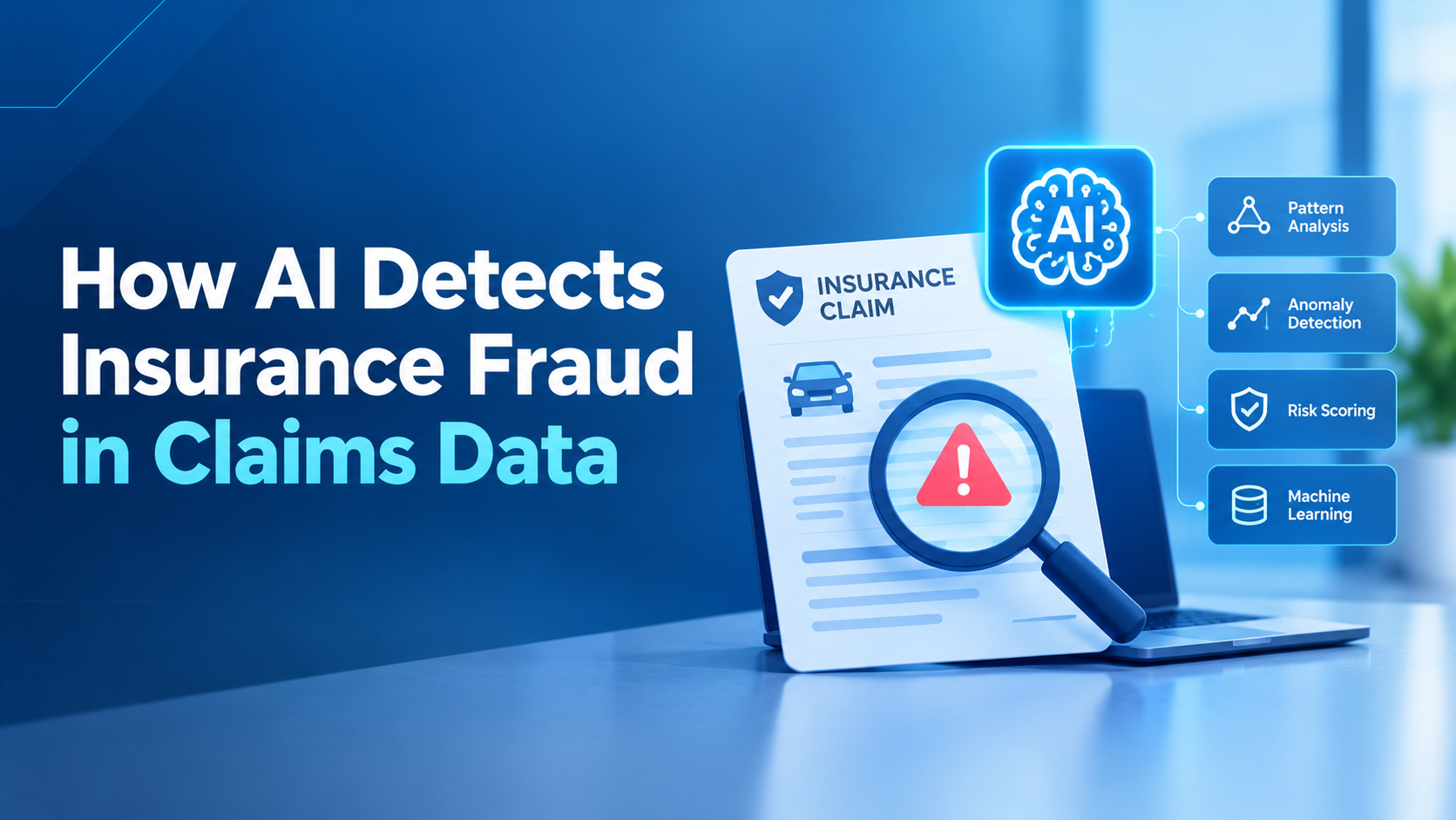
AI analyzes claims data to identify unusual patterns, relationships, inconsistencies, and behaviors associated with potential fraud. It can then assign risk scores or generate alerts for further investigation.
How AI Detects Insurance Fraud in Claims Data
Listen to this article
Insurance fraud is becoming harder to detect as fraudsters find new ways to manipulate claims, create false documentation, exaggerate losses, and coordinate activities across multiple claims.
Traditional fraud detection methods often depend on fixed rules and manual reviews. These methods can identify known red flags, but they may struggle when fraudulent activity does not match an existing rule.
AI changes this approach by analyzing large amounts of claims data and looking for patterns that may not be obvious to human reviewers. Machine learning models can compare new claims with historical data, identify unusual behavior, assign risk scores, and help investigators focus on the claims that need closer attention.
Research has shown that both supervised and unsupervised machine learning can be useful for insurance fraud detection, including approaches designed to identify previously unseen anomalies.
Table of Contents
- What Is AI Insurance Fraud Detection?
- How AI Detects Fraud in Insurance Claims
- What Data Does AI Use to Detect Insurance Fraud?
- AI Techniques Used for Insurance Fraud Detection
- How AI Identifies Suspicious Claims
- AI Fraud Scoring: How Insurers Prioritize Claims
- Benefits of Using AI for Insurance Fraud Detection
- AI Insurance Fraud Detection in Auto and Health Claims
- AI vs Traditional Rules-Based Fraud Detection
- Challenges of AI Insurance Fraud Detection
- How Human Investigators Work With AI
- How to Implement AI for Insurance Claims Fraud Detection
- Is AI Insurance Fraud Detection Worth It?
- Conclusion
- FAQs
What Is AI Insurance Fraud Detection?
AI insurance fraud detection uses artificial intelligence and machine learning to identify claims or claim-related activity that may indicate fraudulent behavior.
Instead of checking every claim manually, an AI system can analyze large volumes of structured and unstructured information and identify unusual patterns.
For example, a system may notice that:
- A claimant has submitted several similar claims within a short period.
- Multiple claims involve the same repair provider.
- A claim amount is unusually high compared with similar claims.
- Information in a claim narrative does not match other available records.
- Several people, addresses, providers, or accounts appear repeatedly across different claims.
The system can then assign a fraud risk score or generate an alert for further investigation.
How Traditional Insurance Fraud Detection Works
Traditional systems often rely on predefined rules.
For example, an insurer might create a rule that flags claims above a certain amount or claims submitted shortly after a policy begins.
Rules can be useful for detecting known patterns, but they need to be manually created and updated. When fraudsters change their behavior, existing rules may no longer be enough.
How AI Changes Claims Fraud Detection
AI can learn patterns from historical data instead of relying entirely on predefined rules.
A machine learning model can analyze previously investigated claims and identify characteristics associated with fraudulent activity. Other AI approaches can look for unusual behavior even when there is little or no labeled fraud data.
This makes AI useful for both known fraud patterns and certain types of emerging or unusual activity. Research using real insurance claim data has found that unsupervised methods such as isolation forests can also identify fraudulent claims.
Why Claims Data Matters for Fraud Detection
Fraud often becomes visible through relationships and patterns rather than a single piece of information.
A single claim may look normal on its own. However, when it is compared with years of claims history, policy information, provider relationships, payment records, or other connected data, suspicious patterns may become easier to identify.
This is why AI fraud detection becomes more powerful when insurers can analyze claims data across a broader business context.
How AI Detects Fraud in Insurance Claims
AI-based fraud detection generally follows a series of steps, from collecting claims data to generating risk scores and supporting investigators.
Collecting and Preparing Claims Data
The first step is bringing relevant data together.
Depending on the type of insurance, this can include:
- Claim details
- Policy information
- Customer history
- Previous claims
- Payment information
- Provider information
- Repair information
- Claim documents
- Claim descriptions
- Investigation records
The data must then be cleaned and prepared so that AI models can analyze it consistently.
Identifying Unusual Claim Patterns
AI models examine claims for patterns that differ from normal behavior.
For example, a claim may have an unusually high amount, unusual timing, an unexpected combination of attributes, or a relationship with other suspicious claims.
Anomaly detection is particularly useful when the insurer does not have enough labeled examples of a particular type of fraud.
Scoring Claims for Fraud Risk
Instead of simply marking a claim as “fraud” or “not fraud,” many systems assign a risk score.
A higher score means the claim contains more signals associated with potential fraud.
Investigators can then prioritize high-risk claims rather than spending the same amount of time reviewing every claim.
Comparing Claims With Historical Data
Historical claims provide important context.
AI can compare a new claim against previous claims involving similar products, incidents, locations, providers, customers, or claim amounts.
This helps identify cases that are significantly different from normal historical patterns.
Detecting Connections Between Claims, People, and Providers
Fraud may involve multiple individuals or organizations rather than a single claim.
Network and relationship analysis can help identify repeated connections between claimants, providers, addresses, phone numbers, repairers, or other entities.
This can be particularly useful when investigating organized fraud networks.
What Data Does AI Use to Detect Insurance Fraud?
The quality and range of available data can significantly affect the usefulness of an AI fraud detection system.
Claim Details and Transaction Data
Claim data can include the type of incident, date, location, amount requested, amount paid, claim status, and other transaction information.
AI can compare these details with similar claims and identify unusual combinations.
Policyholder and Policy Data
Policy information can provide additional context around a claim.
Examples include policy age, coverage type, policy changes, previous claims, and other relevant information.
AI can identify patterns that may deserve further investigation without automatically determining that a customer has committed fraud.
Provider and Repairer Data
In auto, health, property, and other insurance segments, providers can play an important role in claims.
AI can analyze provider activity and identify unusual patterns, such as unusually high claim volumes, repeated connections with suspicious claims, or behavior that differs significantly from peers.
Claims History
Previous claims provide valuable behavioral context.
A single claim may appear normal, but repeated claims involving similar circumstances can create a different risk profile.
Unstructured Claims Data and Documents
Insurance claims contain more than structured database fields.
They may also include:
- Claim narratives
- Emails
- Adjuster notes
- Medical documents
- Police reports
- Invoices
- Repair estimates
- Other supporting documents
Natural language processing and document intelligence can help extract useful information from this unstructured content.
AI Techniques Used for Insurance Fraud Detection
Different AI techniques can address different fraud detection challenges.
Supervised Machine Learning
Supervised machine learning uses historical examples where claims have been labeled as fraudulent or legitimate.
The model learns relationships between claim characteristics and known outcomes.
Algorithms such as gradient boosting, random forests, and other classification models can then be used to estimate fraud risk for new claims.
Unsupervised Machine Learning
Unsupervised models can identify unusual patterns without requiring every claim to have a fraud label.
This is useful because insurers may have limited confirmed fraud cases compared with the total number of claims.
Isolation forests are one example of an unsupervised approach studied for insurance fraud detection.
Anomaly Detection
Anomaly detection looks for claims that differ significantly from expected behavior.
For example, a claim could be unusual because of its amount, timing, combination of characteristics, or relationship with other records.
An anomaly does not automatically mean fraud. It simply indicates that the claim may deserve additional attention.
Predictive Analytics
Predictive models use historical information to estimate the likelihood of future outcomes.
In insurance, predictive analytics can help prioritize claims based on the probability that they contain fraud indicators.
Graph and Network Analysis
Graph-based approaches focus on relationships between entities.
For example, a system could identify connections between multiple claimants and the same provider or discover that different claims share addresses, phone numbers, vehicles, or other identifiers.
This can help expose patterns that are difficult to identify by examining claims individually.
Natural Language Processing
NLP can analyze text-based claims information.
It can help identify inconsistencies, repeated phrases, unusual descriptions, or information that may require further investigation.
Modern insurance fraud systems increasingly combine structured data analysis with text and document analysis.
How AI Identifies Suspicious Claims
AI does not necessarily look for one obvious sign of fraud. Instead, it can combine multiple signals.
Unusual Claim Amounts
A claim amount that is significantly different from comparable claims may be flagged for review.
The system can consider factors such as claim type, location, policy coverage, historical averages, and other relevant variables.
Repeated or Similar Claims
Repeated claims involving similar circumstances can create a potential risk signal.
AI can compare current claims with previous claims and identify recurring patterns.
Inconsistent Claim Information
Different parts of a claim may contain information that does not appear to match.
AI can compare structured fields, documents, narratives, and other records to identify potential inconsistencies.
Unusual Claim Timing
Timing can also provide useful signals.
For example, an unusual increase in claims shortly after a policy change or other event may warrant further investigation.
Suspicious Provider or Customer Relationships
AI can analyze relationships across claims.
If several apparently unrelated claims repeatedly involve the same provider, address, contact information, or other entity, the relationship itself may become a risk signal.
Multiple Signals Appearing Together
The strongest signal may come from several smaller indicators appearing at the same time.
For example, an unusually high claim amount combined with a short policy history and repeated provider connections may produce a higher overall risk score than any one factor alone.
AI Fraud Scoring: How Insurers Prioritize Claims
Fraud scoring helps insurers turn large amounts of claims information into an actionable investigation queue.
Assigning a Fraud Risk Score
The AI model evaluates relevant claim characteristics and generates a risk score.
The score can represent how closely a claim resembles known fraudulent behavior or how unusual it appears compared with normal claims.
Ranking Claims for Investigation
Claims can be ranked based on their risk level.
Investigators can then focus their time on higher-priority cases instead of reviewing every claim with the same level of attention.
Research on machine-learning-based insurance fraud detection has specifically examined fraud scores and their ability to prioritize potentially fraudulent claims.
Reducing Manual Claim Reviews
AI can help reduce the number of claims that require intensive manual analysis.
This does not mean every low-risk claim should automatically be approved. Instead, AI can help allocate investigation resources more efficiently.
Supporting Special Investigation Units
Special Investigation Units (SIUs) can use AI-generated signals as an additional source of evidence.
Investigators can review why a claim was flagged, examine supporting records, and decide what action is appropriate.
Benefits of Using AI for Insurance Fraud Detection
Earlier Fraud Detection
AI can analyze claims as they move through the claims process and identify potential risk signals earlier.
Earlier detection can give insurers an opportunity to investigate suspicious activity before losses increase.
Faster Claims Investigation
Instead of searching manually through large amounts of information, investigators can start with AI-generated risk indicators.
This can shorten the time required to identify which claims deserve deeper review.
Reduced Manual Work
Claims teams often handle large volumes of information.
AI can automate parts of the data analysis process, allowing employees to spend more time on investigation and decision-making.
Better Use of Investigation Resources
Investigation teams have limited capacity.
Risk scoring can help them prioritize cases where additional investigation may provide the greatest value.
Improved Detection of New Fraud Patterns
Unsupervised learning and anomaly detection can help identify unusual activity that does not exactly match previously defined rules.
However, AI should not be treated as a guarantee of detecting every new fraud scheme.
AI Insurance Fraud Detection in Auto and Health Claims
Different insurance categories create different fraud detection challenges.
Detecting Fraud in Auto Insurance Claims
Auto insurance fraud detection can involve information such as vehicle details, accident circumstances, repair estimates, claim amounts, previous claims, and relationships between claimants and repair providers.
A research study using thousands of automobile insurance claims evaluated both supervised and unsupervised machine learning approaches for fraud detection.
Detecting Fraud in Health Insurance Claims
Health insurance claims can contain complex relationships between patients, providers, procedures, diagnoses, payments, and treatment patterns.
AI can analyze these relationships to identify unusual billing or utilization patterns.
Recent research has also explored machine learning approaches designed to make healthcare claims fraud detection more secure and explainable.
Detecting Fraud Across Multiple Claim Types
The same general AI principles can be applied across different insurance lines, but models need to be trained and evaluated according to the characteristics of each business.
What represents unusual behavior in auto insurance may be completely normal in health or property insurance.
AI vs Traditional Rules-Based Fraud Detection
Both approaches can have a role in modern fraud detection.
Rules-Based Fraud Detection
Rules are useful when insurers already understand a specific fraud pattern.
They are relatively straightforward to create and explain.
The limitation is that a rule usually needs to be created before it can detect a particular pattern.
AI-Based Fraud Detection
AI can identify statistical patterns and relationships within large datasets.
It can analyze many variables simultaneously and identify combinations that may be difficult to capture with simple rules.
Combining Rules With Machine Learning
Insurers do not necessarily need to choose between rules and AI.
A combined approach can use established business rules alongside machine learning and anomaly detection.
This allows known risks to continue being monitored while AI searches for less obvious patterns.
Challenges of AI Insurance Fraud Detection
AI can improve fraud detection, but implementing it successfully requires careful planning.
Poor Data Quality
AI models depend on the data available to them.
Missing, inconsistent, duplicated, or outdated claims information can reduce model effectiveness.
Limited Fraud Labels
Confirmed fraud cases are often much smaller in number than legitimate claims.
This imbalance can make supervised machine learning more challenging and is one reason insurers may combine supervised and unsupervised methods.
False Positives
Not every unusual claim is fraudulent.
If a system flags too many legitimate claims, investigators may become overwhelmed and customers may experience unnecessary delays.
A good system therefore needs to balance fraud detection with investigation capacity and customer experience.
Changing Fraud Patterns
Fraudsters can change their methods.
A model that performs well today may need to be monitored and updated as new patterns emerge.
Model drift and changing fraud strategies are recognized challenges in AI-based fraud detection systems.
Data Privacy and Security
Insurance claims can contain highly sensitive personal, medical, and financial information.
Insurers need appropriate controls for data access, storage, processing, and model usage.
Explainability and Regulatory Requirements
Investigators and business teams need to understand why a claim was flagged.
Explainability becomes especially important when AI outputs influence claims decisions.
The goal should be to use AI as decision support rather than treating an unexplained model score as a final determination of fraud.
How Human Investigators Work With AI
AI works best when it supports experienced investigators rather than completely replacing them.
AI Flags Suspicious Claims
The AI system analyzes available data and identifies claims that require attention.
Investigators Review Risk Signals
Investigators examine the reasons behind the alert and review relevant evidence.
Human Judgment Supports Final Decisions
An AI-generated risk score should not automatically determine whether a claim is fraudulent.
Human investigators can consider context that may not be fully represented in the model.
Investigation Results Improve Future Models
Confirmed investigation outcomes can become useful feedback for future model development.
Over time, this creates a cycle in which investigation results help improve fraud detection capabilities.
How to Implement AI for Insurance Claims Fraud Detection
Implementing AI is more than selecting a machine learning model.
Define Fraud Detection Goals
Insurers should first identify what they want the system to accomplish.
Possible goals include reducing investigation workload, detecting organized fraud, identifying suspicious claims earlier, or improving fraud prioritization.
Connect Relevant Claims Data
Relevant information should be brought together from claims, policy, payment, provider, customer, and other appropriate systems.
A broader data view can make it easier to identify relationships and patterns.
Select the Right AI Models
The appropriate model depends on the type and availability of data.
Supervised learning may be useful when reliable fraud labels exist, while anomaly detection and unsupervised methods can help identify unusual behavior where labeled examples are limited.
Test and Validate Fraud Models
Models should be tested against historical data and evaluated using appropriate metrics.
Accuracy alone is not enough when fraudulent claims are relatively rare.
Precision, recall, false-positive rates, and investigator capacity can all matter.
Integrate AI With Claims Workflows
Fraud detection becomes more useful when it fits naturally into the existing claims process.
AI alerts should reach the appropriate teams at the right stage of the workflow.
Monitor Model Performance
AI models need ongoing monitoring.
Insurers should track changes in fraud patterns, model performance, false positives, investigation outcomes, and data quality.
Is AI Insurance Fraud Detection Worth It?
For insurers dealing with large claims volumes, AI can provide a practical way to analyze more information and prioritize investigations.
When AI Makes Sense for Insurers
AI may be particularly valuable when an insurer has:
- Large claims volumes
- Significant historical claims data
- A growing investigation backlog
- Complex fraud patterns
- Multiple connected data sources
- Limited investigation resources
When Better Data Should Come First
If claims data is fragmented, incomplete, or unreliable, improving the data foundation may need to happen before deploying advanced AI.
Better models cannot fully compensate for poor-quality information.
Why AI Should Complement Human Expertise
Fraud detection is not simply a classification problem.
Investigators understand business context, customer circumstances, evidence, and exceptions that may not be visible in structured data.
AI can help them find relevant signals faster, while human expertise remains important for investigation and final decisions.
Conclusion
AI is changing how insurers approach fraud detection by moving beyond simple rules and manual claim reviews.
By analyzing claims data, historical patterns, relationships, documents, and other signals, AI can identify unusual activity and help insurers prioritize claims for investigation.
Machine learning, anomaly detection, predictive analytics, graph analysis, and natural language processing can each contribute to the process. Research has shown that both supervised and unsupervised approaches can be useful, particularly when insurers need to detect both known and less familiar fraud patterns.
However, AI should not be viewed as a system that automatically decides whether a claim is fraudulent. Its greatest value is in helping claims teams and investigators find potential risks faster, analyze more information, and focus their resources where they are most needed.
For insurers, the strongest approach is usually a combination of quality claims data, AI-driven analysis, clear workflows, continuous model monitoring, and human investigation.
Ready to take the next step?
Frequently Asked Questions
AI can use claims information, policy data, customer history, previous claims, payment records, provider information, documents, claim narratives, and other relevant data sources.
Common approaches include supervised classification, unsupervised learning, anomaly detection, predictive analytics, graph analysis, and natural language processing. Research has specifically examined methods such as XGBoost and isolation forests for insurance claims fraud detection.
AI can help reduce unnecessary alerts by considering multiple signals instead of relying on a single rule. However, false positives cannot be eliminated completely, so models need continuous testing and monitoring.
No. AI is better viewed as decision support. It can prioritize suspicious claims and surface useful patterns, while investigators review evidence and apply human judgment.
Insurers can begin by defining fraud detection goals, improving data quality, connecting relevant claims data, selecting appropriate AI models, testing them, integrating alerts into claims workflows, and continuously monitoring performance.